Sunday, June 12, 2016

Cape May's Secret Garden Tour

 My usual sidekick couldn't make it to the garden tour because of an illness in her family. Pneumonia scares me, so I actually encouraged her to stay home even though this would mean I'd have to navigate the tour and the lunch following at the Chalfont Hotel by myself.

Or would I? I stopped at the Washington Street Information Booth to pick up my tour packet and I was aware of a name-tagged garden tour official giving a big welcome to a pair of women who had arrived just after me. Before I claimed my tickets and packet, I realized that one of the women was Janice Wilson Stridick, who is a second-generation celebrity in Cape May. She wrote a stunning book called Light, Particularly about her mother, painter Alice Steer Wilson, and Alice's watercolors of Cape May. If you love Cape May, gardens, or watercolor paintings, you should probably have this book. If you love all three, you should definitely have it.

Janice and I run into each other periodically in Cape May. I offered her my extra ticket and we were off to visit the ten gardens with Janice's niece, Kim. The houses were in parts of Cape May that I don't frequent often--outside of the touristy beach and historic areas. I'd seen some of the homes from the front and admired their public, front-facing gardens, but being allowed in the private back gardens was a treat. These are the outside places where residents enjoy their homes in privacy.

All ten gardens were gorgeous: "One more beautiful than the next," as my mother would have said. There were begonias, ferns, magnolias (I bragged about the giant magnolia my father planted here), geraniums, and hydrangeas, all of which love the Cape May climate and sandy soil. I learned from Janice about lobelia, a plant featuring small blue flowers that grows very well in Cape May and looks great in blower boxes and planters.
lobelia
Janice also pointed out the Japanese ferns and mentioned that they are quite hardy. At the Aurorean Cottage on Corgie Street, we learned about the pair of Harry Lauder Walking Stick trees in the front. The branches of these trees are twisty as you can see from the picture.
Harry Lauder Walking Stick Tree
In-between gardens, Janice and I caught up. I met her when she was teaching English Composition at Bucks County Community College because being a librarian there, I work with that faculty often. She's not teaching college courses anymore but filled me in on what she is doing, besides touring for the book about her mother. Click on her name in the first paragraph to see what she's cooking up. Kim and Janice were both very interested in Cape May's Sherlock Holmes Weekend which I have participated in a few times. No, I assured them, you do not have to wear a costume. I blogged about that experience here.

Many of the gardens included on this tour featured garden "rooms." Under an arbor covered with old, hardy wisteria might be a lounge chair and end table for reading,
That's some 'established' wisteria!
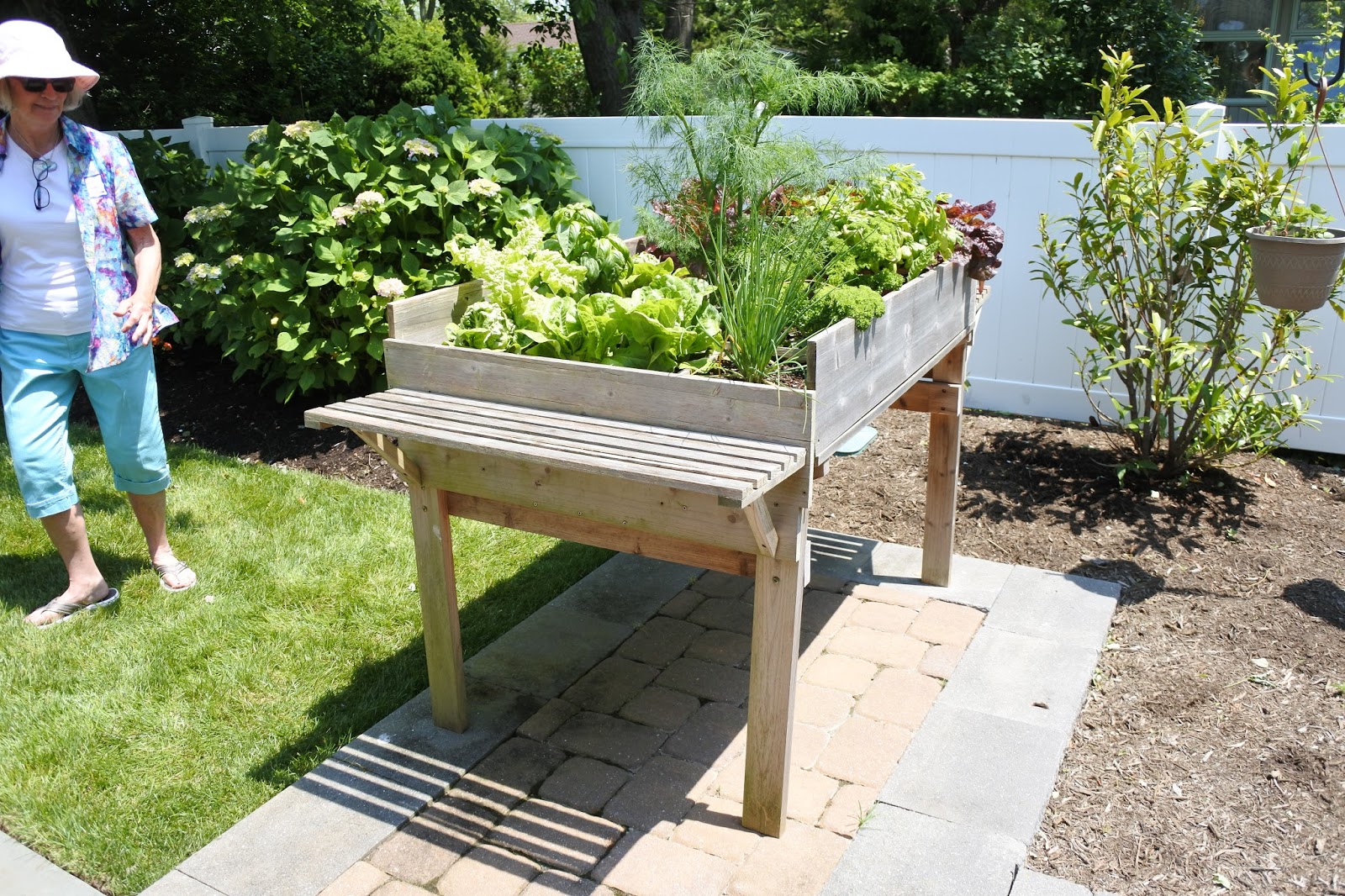
but tucked away in a corner might be a sunnier bistro area. If you keep looking you might find a hammock among the ferns, hosta, and elephant ears. One garden featured a waist-high raised bed which seemed to be growing all of the ingredients for salad.
Really raised bed

The ornaments! Gardeners seem to love whimsy judging by how they decorate their gardens. I saw frogs, a frog fountain, a patchwork pig, mesmerizing artistic whirligigs catching the sea breezes, and antique statuary. There were gazing balls and stepping stones. Did I mention there were flowers everywhere?


Each garden also boasted a painting of the garden in which it was displayed by a local artist. These paintings were being silent-auctioned off. These were marvelous and showed how much thought and planning went into this day! Most of the artists were around to greet admirers, and how lucky am I: Janice knew almost all of them and the garden hosts, too!

After we visited the ten secret gardens, we were to report to the Chalfont Hotel for lunch. I was looking forwardto seeing the inside of the Chalfont Hotel,
and I did, sort of. The luncheon in the Magnolia Room was mobbed. On the one hand, this shows how popular the Garden Tour was, and it was good to see how many people turned up for it. Proceeds were to benefit a good cause--the Cape May Forum--and it is satisfying to see cultural Cape May celebrating itself. On the other hand, I was wondering how I was still standing after all that walking in increasingly sweltering heat when I hadn't been properly hydrating. I didn't want to be impolite, but it was going to be a while before we got to the buffet table...so I said good bye to Janice...and ghosted out...

As luck would have it, right near the stitchery store (where I picked up some DMC 3345 for a current project), I discovered Cione Gelato. According to the woman who scooped my Stracciatella and Chocolate, they have been there eight years. HOW have I not noticed that shop before, especially when it is sandwiched between the stitchery store and the gourmet shop which makes its own fresh pasta? Maybe it was a mirage, but I'm pretty sure that gelato (or the idea of it) saved my life!

So here's a round-up of Saturday's discoveries:
  • LOBELIA
  • JAPANESE FERNS are hardy
  •  HARRY LAUDER WALKING STICK TREES
  • GARDEN "ROOMS"
  • WAIST-HIGH RAISED BEDS
  • CIONE GELATO 
  • STRACCIATELLA means chocolate chip
I'm inspired!


Saturday, May 28, 2016

Dead Writers of Concord

Orchard House, Concord
Oh how I enjoyed our three days in Concord! We were excited to see Louisa May Alcott's Concord House. Her classic novel Little Women was set in this house and the sisters in the novel were based on her own sisters. The tour was delightful, and we learned about Louisa May--she was very much like the fictional Jo, but not completely. The house felt welcoming, even after all these years, and it was more than a little thrilling to be in this famous house. Later, we visited Sleepy Hollow Cemetery which may sound morbid, but consider this: on a hill overlooking the park-like graveyard, Louisa May Alcott, Henry David Thoreau, Nathaniel Hawthorne, and Ralph Waldo Emerson are buried. If you go, and would like to leave something to honor them, bring some pens and pencils.

Louisa May Alcott's collection of pens and pencils

The Alcott family monument
You remember Henry David Thoreau from Walden Pond, yes?
(That's not him, but that is Walden Pond)
 The Thoreau family is buried next to the Alcotts.

The Thoreau family monument
Henry David Thoreau the naturalist has a nice collection of natural items along with his pencils and pens.


Nearby, we found Ralph Waldo Emerson's grave in a sea of other Emersons.

Ralph Waldo Emerson has a distinctive grave marker, yes?
 

The Emersons were a big Concord family and there are Emerson artifacts all over town. RW's study has been reconstructed in the Concord Museum, and his house, just down the street from Orchard House, is a museum in its own right...
Ralph Waldo Emerson's house
...and Emerson's grandfather, Rev. William Emerson, was an important minister in Concord whose house is also a museum:

Rev. William Emerson's Old Manse
The Old Manse is important because Ralph Waldo Emerson lived there for a time during which he wrote "Nature," and Nathaniel Hawthorne and his wife "rented" the place for a few years although they never paid any rent. They were very romantic and etched notes to each other in the window glass with her diamond ring:
Can you see the Hawthornes' etchings in the glass?
Outside another window we could see the bridge from which The Shot Heard 'Round the World was fired--this started the American Revolution, right here in Concord!

Hawthorne's grave is on Author's Ridge in Sleepy Hollow Cemetery, too. His wife and daughter Una died in England and were buried there in 1871 and 1877, but were moved home to Concord in 2006 to be with Nathaniel.

Hawthorne's daughter Una was born in the Old Manse!
I came home with many photographs and a car full of books from this interesting, historic town, birthplace of Transcendentalism. But most importantly, I'll have the memories, thrilling memories, of standing in these authors' houses, gardens, and favorite haunts, and paying respects at their graves. It was a different kind of vacation, and a transformative one.

Thursday, April 7, 2016

The Monks' Mandala


You'll never guess what I did at work today! After lunch, Brian and I walked down to see the Tibetan Monks from the Drepung Gomang Monastery who are spending this week "in residence" at Bucks County Community College. They are making a mandala out of dyed sand on the floor of the Solarium. This thing is so intricate and colorful that I doubt my iPhone photos will do it justice.

When we arrived at the Solarium, the monks were taking a lunch break, but there were many visitors and Bucks-affiliated people gawking at this fantastic work-in-progress. If you look closely at the photo above, you can see the design sketched out on the blue base. Sometime tomorrow (approximately 12:30pm), that blue section will be finished and the mandala sand will be swept up in a ceremony and brought to the park where it will be dropped in the creek. Some of the sand will be distributed to the audience as a blessing.

After a few minutes, the monks finished their lunch and returned, one-by-one, to their work.

One monk...
 They hold two long, thin funnels made of metal. One funnel holds the colored sand, and the other is used to tap the sand-holding funnel controlling how fast the sand comes out.

...two monks...

If I were to say that these mandalas are created one grain of sand at a time, I would not be exaggerating. Nevertheless, these expert sand artists covered quite a bit of the mandala while we watched.

...four monks and a basket of tools.
These "sand-painted" mandalas are considered tools for consecrating the earth and people. They represent the universe and its inner and outer meanings. I am no expert on their symbolism, but these monks were kind enough to furnish us with thorough background information on this tradition which is hundreds of years old. All who view the mandala are supposed to experience "profound peace and great joy." This was a welcome inspiring experience in the middle of a mundane work day, and thus did give us peace and joy. ;-)

But wait there's more... everyday this week when I walked past the Solarium on my way to the cafeteria I heard the singing bowls. It's a beautiful, hollow, metal sound and has a pleasing quality. Well, the monks had a table set up with jewelry and prayer flags for sale...and...bowls. Reader, I bought one.
My singing bowl on my desk.
I will now try to make it sing for you.


My video isn't great, so chill out with this guy who has many singing bowls, gongs, and crystals:

Wednesday, March 9, 2016

The Unexpected Vienna


Statue of Johann Strauss II in Vienna's Stadtpark
It has been eight months since I visited Vienna, and in those months I have been writing and thinking about the city and my own experience there. I wrote a pretty good literary essay about why the city was a European nucleus of musical activity (largely support from the Hapsburg monarchy, it turns out), and another essay about Viennese affection for the Waltz King, Johann Strauss II. I winnowed my collection of photos to just a few hundred. All the while I was reflecting on what little piece of that transformative two weeks would be appropriate and interesting to share on this blog. And then it hit me: why not tell my readers about the unexpected Vienna, the stuff that surprised me.
Some of my companions approach the Reisenrad
There's a Ferris wheel in Vienna. That wasn't a surprise by itself--London and Paris have wheels. The Vienna wheel, the Riesenrad, is in the amusement park called the Prater, is one of the oldest wheels in the world. It was built in 1897, so it's possible Sigmund Freud, Johann Strauss II, and even Johannes Brahms rode it. Gustav Mahler could have, too, but I'm not sure he was living in Vienna that year.

The gondolas are big and hold at least twelve people who are permitted to walk around the car to see the views on each side. The ride moves slowly, so although you get only one rotation, you have plenty of time at the top to gaze down on the city.
From the top of the Reisenrad: that's a wax museum over there.

Some of the gondolas are outfitted with dining apparatus, at least one formal and one informal, and for an extra cost riders can enjoy a multi-course meal. Each course is delivered when the gondola reaches the bottom point.
Views of the Riesenrad
Vienna view from the Riesenrad
I toured the famous Vienna Opera House and learned that Gustav Mahler is one of the most-esteemed conductors in the opera house's history. I think of him as a composer of symphonic works, but unbeknownst to me, he was a sought-after conductor in his time specializing in opera. Vienna recruited him from the Budapest Opera. He made big changes during his time in Vienna including forbidding audience members to enter the auditorium once the opera had started and from cheering on their favorite singers. There were tributes to him all over that place including a bust by non other than Auguste Rodin. Way to go, GM!
The Vienna Opera at night
Just across the street from the Opera House is the Sacher Hotel, where the famous Sacher Torte is served. I can't say I was unaware of this famous pastry since my sister recommended I go there to try it, but I was delighted at how yummy it is. It's made from a secret recipe that bakers have attempted to duplicate, but there's nothing like the original at the original place. That fruity taste in there is apricot if you didn't know.
The original Sacher Torte at the Sacher Hotel
Johann Strauss II's Local Hero status did not surprise me even though he and his waltzes, polkas, and operettas were not mentioned in my American Music History training. Really: we music majors were warned not to get involved with "light" music of any kind, and this included John Philip Sousa marches, folk music, and American Musical Theater. I had  no idea there was a whole family of musical Strausses until I was inspired to write an essay about how defensive I became when I overheard a young American man slandering JS II's music after a Vienna concert. That's what surprised me, that I was inspired to defend this composer, research his life and career, and go in search of the famous Stadtpark statue and his apartment on the Praterstrasse which is now a museum.
Johann Strauss II's apartment is up there
I learned about his three (consecutive) wives, his musical father and two brothers, and became familiar with his waltzes, polkas, and operettas. I noticed his music meant as background being played in the hotel breakfast room, gift shops, my Austrian Airlines flight, and back home on my CD alarm clock. Once I noticed the music in these places, it took on a surreal quality as if it was inappropriate for the surroundings. It's good stuff, though, and I enjoyed including it along with Mozart's, Beethoven's, and Mahler's in the Music of Vienna course that I taught in the fall. When New Year's Day came along, you bet I was in front of the television watching the concert broadcast from Vienna. It looked similar to this:
This "Radetsky March," by the way, was played over and over in our hotel breakfast room. Did anyone else notice it, I wonder?

Saturday, January 9, 2016

Mallards & Buffleheads & Goldeneyes

The lake trail (with some other guy and his sweatered bulldog up ahead)
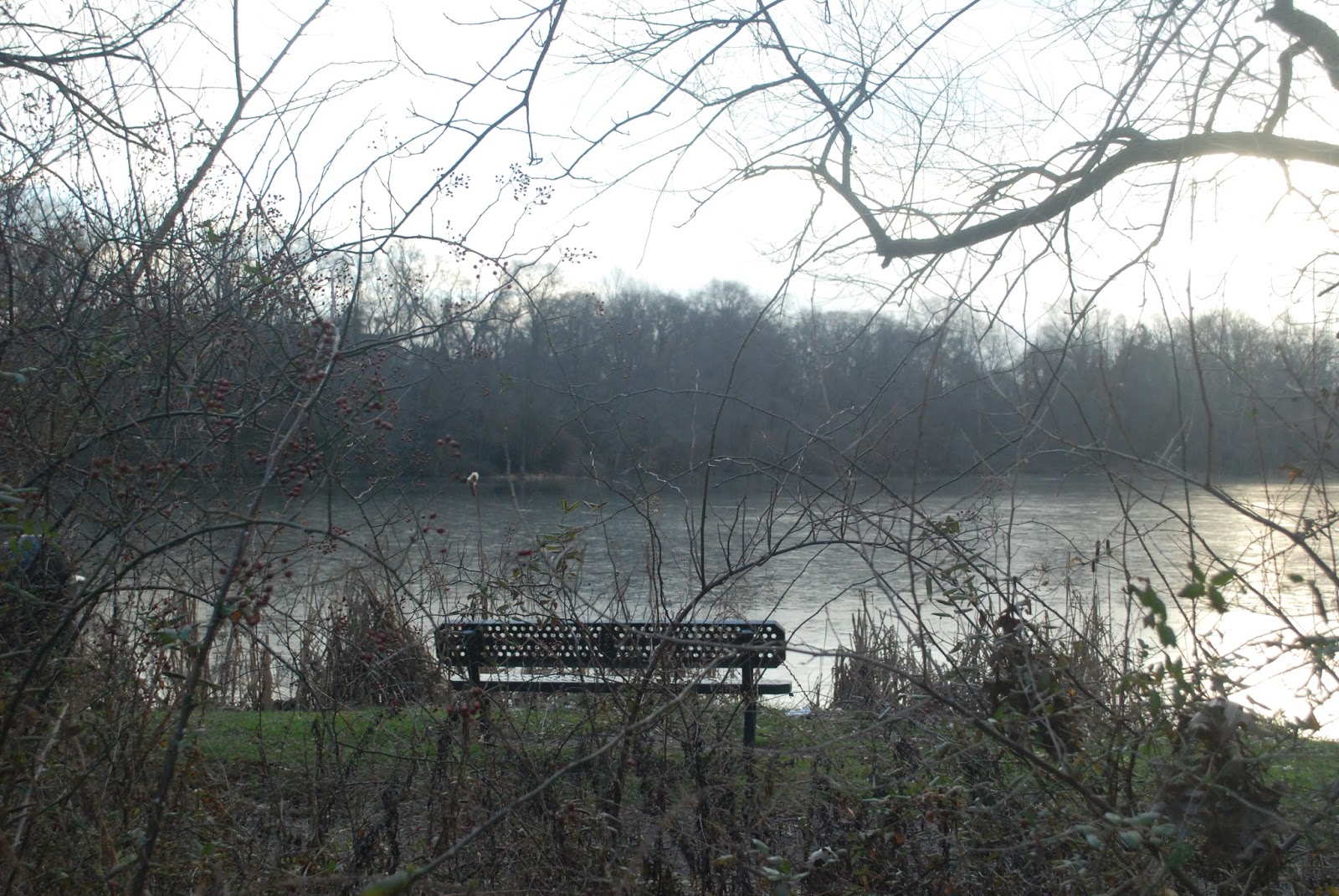
Good Morning, Readers. Fred and Gladys and I have been walking in the Hamilton-Trenton Marsh lately, not as a formal New Year's exercise resolution, but just 'because'. One of these days I will remember to set the pedometer app to measure the walk, but I estimate that it is about two miles: from the house, around the corner, down the hill, around the lake, up the hill, and back home. This post is more pictorial than literary, and I hope you will have the sensation that you came along with us but without the ever-so-slight ache in your calves. BTW, this area is also known as John Roebling Park, Spring Lake, and most recently, Abbott Marshlands.

Beaver architecture, ca. 2016
This is Spring Lake
Action shot: Gladys loves the Marsh!
Tree down! This tree always dreamed of being a dock.
Water Snakes: usually I don't see these.

ROOTS...


AND BERRIES...


and BIRDS:

Look between the Phragmites to see the Mallard
Goldeneyes? Buffleheads? I think I saw some of each, but I walked away without good evidence.
The soundtrack of our walk was provided by these noisy Canada Geese.
As you can see by our walk, there's plenty of life being lived in the winter marsh. I'm not 100% sure that my bird identifications are 100% correct, but I did my best post-walk research with my Peterson and Kaufman bird guides. It is a truth universally acknowledged by birders that birds in the wild do not stand still to pose for photographers or amateur birders. What fun would it be if they did?