Monday, April 12, 2010

The Cape May County Zooooo


There's a short list of things I like to do in the Cape May area that are free. (Sometimes this matters more than others.) Along with walking along the bay, shooting photos of the sunset, visiting Jersey Shore Alpacas, and checking out the flowers at the Hereford Inlet Lighthouse, the Cape May County Zoo is a great way to spend some time. Every time I go, it seems that there are improvements and more people milling about. This Sunday I was almost disoriented with new buildings and new parking lots meant especially for zoo visitors. The old parking lots are now designated "park parking." Okay, I can deal with change.

First up is the barnyard: chickens, pigs, goats and sheep. I never get tired of these guys.

One of the things I like about this zoo is the elevated boardwalks:

These allow zoo visitors to walk above the more exotic animals and get great photos without a lot of bars and fences in the way. That's how I got these cool shots (along with my longer lens).

These nattily-dressed creatures are part of the African Savanna section:

This is the best photo I've gotten of this snow leopard in years of attempts. He is behind a fence and I somehow got it to blur! (Look at the size of those paws!)

I skipped the Aviary and the Reptile House this visit, because there's just too much to see in a short visit. The lion was reclining, and because of this not a great photo subject, but we could all hear him pretty much all over the zoo. I wonder what the other creature think of his roars!

Saturday, March 20, 2010

Exploring the Formerly Scruffy, Always Charming, Cape May Point


I am a tourist when I go to Cape May Point: I visit the lighthouse


and Sunset Beach.

I relax on the beach by the lighthouse which is now a state park. Birding is big there, but I seem to lack the birder's eye that can identify an unusual bird by just its tail feathers or the color of its feet.

I thought it might be fun to write a piece about Cape May Point, familiar to me but not quite. This quiet neighbor to uber-popular Cape May seems to have its own personality. I like exploring what lies beneath the surface of places.

As part of my research into what makes Cape May Point...Cape May Point, I interviewed Rich Chiemingo, a lifelong resident, at least in summers, and self-described Cape May Point hermit. He keeps busy today educating visitors of all ages about John Philip Sousa, Doo Wop music, the Cape May Point Lighthouse and the Twin Capes' involvement in World War II history

for Cape May's Mid-Atlantic Center for the Arts and Humanities. (http://capemaymac.com/index.html) Rich apologized that he was not exactly a font of knowledge. (What?!) He painted for me a picture of what it was like to be a kid in Cape May Point in the 1950s and 1960s as if he had just walked out of a "show, don't tell" writers' workshop. He described an idyllic existence (using all five senses!) cooking hotdogs in beach bonfires with cousins. Those same kids would wait under the fire station's siren pole waiting for the siren to blow while inhaling the smell of the pole's hot creosote. When the noise started they'd run screaming with their hands over their ears. Those tender bare feet would step on wild cactus that really hurt in the beginning of summer but by the end would toughen and not notice the cactus as much.


Television reception was terrible then, but there were Phillies games and Doo Wop music coming out of transistor radios and Rich's older cousin's black Oldsmobile convertible. His memories were at times like a mixture of mine and my older sister's: weekly trips to Cape May's boardwalk and the big annual Wildwood Boardwalk excursion.

I asked Rich what has changed since those magical childhood days and he had two big answers. First, the place has become more developed and more populated. (We agreed that the homes of today are gorgeous, though, and he added that Cape May Point's properties are consistently well-kept.) Rich used the word "scruffy" to describe those early days, but emphasized that he meant scruffy in a positive, natural, primitive and charming way. I know exactly what he means because my little section of beach paradise was like that, too, until the grandiose, modern beachfront homes started appearing in place of the tiny fishing shacks with concrete-block fences. (This scruffiness is close to what I call "Authentic Cape May" in another article.)

Rich's second answer was that he realized as a young adult that not every kid had this opportunity to run around barefoot all summer. Other kids got to go away for a week or two, but he got to spend the whole summer in this kids' paradise. Yup, it took me awhile to figure that out, too. I am no Oprah, and I dread doing interviews. I get this nagging feeling that I am being too nosey. With every interview I do, though, I come away with a new understanding of a person or a place and in this case, both! Rich's vivid memories fave me the spark to pursue this Cape May Point project.

Later that day I showed up with my camera at Sunset Beach on the edge of Cape May Point. I was surprised but delighted to find the parking lot full (in March), and the beach populated by others experiencing this little piece of authentic Cape May.

Friday, March 5, 2010

Philadelphia Flower Show 2010


I went to the Philadelphia Flower Show Wednesday imagining the blissful afternoon I would spend flitting from one exhibit to another shooting inspired flower photos through Nikon glass. It would definitely be less crowded on a Wednesday than it is on the weekends, right? Wrong. After ninety minutes I had had enough of being pushed and nudged and hurried along, and I took my leave. The theme this year was "Passport to the World" and there were displays featuring New Zealand, Netherlands, South Africa, India, Brazil and Singapore. These, of course, were the most crowded of all.

I loved this elephant and stood there forever for this shot because some whiney brat's yellow smiley face balloon kept popping into the frame. anyway, look closely at the elephant's toes painted with sparkly nail polish. It's all in the details, right?


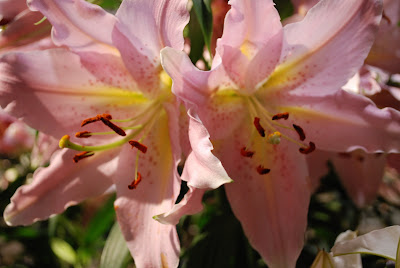
Lilies are always good for some good shots. Stick that camera right up in their faces:
There were many creative displays including this one with little globes of colored water suspended from the ceiling (or a frame, I don't remember) at different heights with assorted flora popping out.
I was surprised to see figs in portable pots. These are the same variety we've been growing at the Cape May house for longer than I have been alive, Turkey Brown. They are green because they are not yet ripe, of course.
These are two of my favorite shots. Just flowers, nothing fancy.

I should add that the Marketplace was not as crowded as the exhibits and I spent some time there. I only bought a small Flowering Maple that I will try to keep alive until summer. If anyone is wondering what to get me for my upcoming birthday, I would like a Bagz-it, an Air Chair, a complete re-landscaping of my backyard, and a special keepsake DVD of the 2010 Flower Show so's I can see what I missed.

Saturday, February 13, 2010

In which Margaret survives for three days without electricity in a blizzard

I drove to North Cape May ahead of the storm, on purpose, because it is so unusual for that area to get more than a few inches. I have rarely seen shovelable snow there, and I have known this house since before I was born. As this was a last-minute adventure decision, I didn't take much time to think about what I might need, but I tossed some extra candles, a candle lighter, warm sweatshirts and socks and easily-prepared food and baked goods into the car. I packed for Gladys the Sheltie, too, since she would be my blizzard partner. She had plenty of toys, food, treats and her little jacket that we call her barka.

The snow started right on schedule, and we watched in awe as it quickly covered the lawn and streets. The lights went out around 4:00 on Saturday. Snow was sticking to the window screens blocking any light from outside, and eventually it stuck to the window glass. In order to see what was going on out there, I had to open the door and peer out. Even with all the white snow it was incredibly dark outside because the bright streetlights were out.

I managed to light the gas log in the fireplace (the first time) for some light and warm. This involves going into the basement to turn a certain stiff valve with pliers and then turning a switch on the side of the fireplace contraption to let the gas out and then lighting the gas with the candle lighter. For a person terribly squeamish around fire and flammable gas (I will not have a gas grill), this was quite a feat. The house got colder each day and the number of blankets making up our hearth-nest grew to about six. At one point Gladys even got under the covers with me.

Cooking was easier because even though I had to light the gas stove the same way as the gas log, it seemed less threatening. However, the kitchen, being in the middle of the house, got dark early. My clip-on LED light and strategically-placed candles could not illuminate well enough to cook or clean up. I left everything I might need out on the counter for the dark time. One afternoon I made Rachael Ray's Zuppa Ossa Bucco (minus anchovies). It was delicious. Leftovers went out on the front porch in my snow-packed cooler.

I never did conquer the challenge of digging out. I made some nice paths in the thirty-inch snow from the front and side doors to the sidewalk, and the neighbor, Kevin, snow-blew the sidewalk. This made a great tunnel for Gladys to get some exercise (we call it the Glunnel).
It turned out very few people in the neighborhood bothered with sidewalks as digging out of cars was more of a priority for most. My car was parked on the street because we don't have a driveway at that house. Plows went by frequently and each time threw more boulders of icy snow into the snow fortification that separated my car from the icy street.
Over two days, I managed to clear a path to each car door
with the plan of clearing the snow away from the exhaust pipes on the third day. this way I could start up the car and sit in it for awhile with Gladys to take advantage of the heated air and seats.

I never got to this as Fred came down with a rescue generator and dug out my car as the house warmed. We were more worried about the house's pipes freezing than Gladys and me. The house had gotten down to the mid-forties--it lost about ten degrees each day. Gladys and I were warm as long as we stayed in our hearth-nest with a book.


I wore layers covered by the fuzzy blue (think Cookie Monster) robe Jeanne sent me for Christmas. That thing was blessedly warm, and sorry, but there are no photos of that. The borrowed generator brought the house heat back up to comfortable and gave me some electricity to charge my laptop, netbook and iPhone. I had sacrificed the laptop and netbook battery power to charge the iPhone, and was now down to nothing.
The next storm on Wednesday, the one that would turn out to be Snowmageddon for Central Jersey, would only blanket Cape May with (only!) six to twelve inches. The generator was going back to Central Jersey and I was preparing to break the news to Gladys that we were going to brave this one, too, when power was restored. I never packed up so fast--got back to Hamilton in time for Snowmageddon II: Central Jersey. Before heading north, though, we went south just a bit to shoot photos of Cape May City in the snow:


Friday, February 5, 2010

Junk Yard Shots

I went to the auto junk yard last week with Fred, and until I got in trouble for shooting photographs (this was not posted, but who would anticipate it?) it was an interesting departure from the ordinary. By 'ordinary' I mean my 'ordinary' because Fred ordinarily comes here often. In fact, he visits all the local junkyards frequently for parts. The idea is this: you find an undamaged part, a wire, or a tire on a junker that works in your vehicle and you buy it for a fraction of the cost of a new one. The vehicles stay around the lot for around 30 days depending on whether new stock is coming in and they have to make room.Bring your tools, because you'll have to remove it yourself. We were in search of a tire for Fred's minivan and so lugged around a jack and a wrench, and other tools I cannot name. (Get it: lugged around?) I happily shot my photos until a guy in a big tractor-looking thing with a car-scooper in front told me no photos were allowed and watched us walk to the van and place the camera safely inside. No photos, fine, but really what horrible misdeeds could I commit? Here are some of those verboten photos carefully chosen so as to not reveal which lot we were at.


Since we were looking for minivan tires, we were mostly in the van/pick-up/SUV department:


Buddy, your back fell off.


Can you find the part you need in there? This spaghetti looks more complicated than usual to me.


This is what's under your bumpers, y'all:


The personal items strewn about was spooky to me. Why? Unless I were on a road trip somewhere and got into a bad wreck, there wouldn't be many personal items other than CDs in my car, and I would retrieve them promptly. Unless... There was one van with a whole lot of women's clothes in it and many brochures on driving under the influence.


While guys pulling parts from these junkers treat the vehicles with some respect (propping up the thing with a found object after removing a wheel for instance), the personal objects are thrown about all over. I suppose customers are hoping to find some treasure in there, but it just added to the gloominess of the place to me.

Wednesday, January 27, 2010

Aesthetic Arrest


Dr. Stimson Carrow introduced the concept of Aesthetic Arrest in a graduate Aesthetics course at Temple University. My classmate Dori and I snickered on the Broad Street Subway after class at the weighty pretentiousness of the term, but it turns out that the concept swirled through the remarkable minds and out through the pens of James Joyce and Joseph Campbell. Far be it from us to question the significance of Aesthetic Arrest.This is that phenomenon of being so overwhelmed with a thing of beauty that you just have to stop everything and stare. It can be a work of art, a scene in nature or even an original thought manifested in a well-built machine. Most of the time, it sneaks up on you. It's almost spiritual, or even completely spiritual.
Aesthetic Arrest snuck up on me Monday. It rained all morning and into the afternoon, and the accompanying wind was strong enough to knock out my phone service. Then the sun came out and I took Gladys (the dog) for a walk along the bay. I brought my Nikon along so that I could shoot some winter beach scenes for another project.

The bright post-storm sunlight changed to that magical golden light that happens just before the sun sets. I love to photograph Gladys in that light, but I think that goldenness would make anyone look good. The clouds were spectacular, probably from the edge of the storm.

Gradually, as I shot some photos for my project, the lovely golden light morphed into an oddly dark, filtered light. The residual storm clouds were covering up the sun, ruining the sunset for those folks in parked cars up on the street. Some of those clouds looked rather threatening and I thought I should probably get Gladys and my Nikon home safe and dry.
I could not get enough, though. It was Aesthetic Arrest for sure. I had never seen the bay quite like this and I have been coming to this beach at every time of day, in every season, for decades. I took more than my share of gorgeous photos.

Anyone know of a good contest?

Sunday, January 3, 2010

Vizcaya


While in Florida last month we visited the Vizcaya Museum and Gardens formerly known as James Deering's winter home. He was the Vice President of International Harvester Company known for its reapers. (Agricultural equipment.) This guy had oodles of money and also maintained homes in Chicago, Paris and New York. This is where he spent his winter months from 1916 to 1925. It wasn't just a mansion but a great experiment in self-sufficiency. Materials and supplies were hard to come by a century ago in remote Miami, so Deering hoped that the workers on his estate could grow, manufacture and build everything they needed to survive. Sixteen to eighteen servants worked inside the mansion while During was away and twenty-six (!!) gardeners keep the gardens manicured. It seemed to work for awhile, until a catastrophic hurricane ruined everything in 1925.
The mansion was rebuilt by Deering's descendants after another earthquake in 1936, but some changes were made in order to preserve the interior. The open courtyard was enclosed by windowed walls in the front and back, and a glass roof covered the enormous courtyard. Prior to this, if you stepped out of your guestroom, you'd be standing on the wide tiled gallery in open air looking over the courtyard. (Hmm, kind of like a classy version of a Motel 6.) The house has a total of thirty-six rooms including a music room, a library and a state-of-the-art kitchen for then. The wealthy of that time saw themselves as successors to the Great European Families, and in order to make this clear to visitors, they collected Great European Art. Vizcaya retains most of its original antique furniture and art from the fifteenth to nineteenth centuries.

Off the East Loggia is the Biscayne Bay. Visitors arriving by boat were greeted by a huge limestone barge which acted as a breakwater. On one side of the barge is a special dock and walkway,
and on the opposite side is a tea house. These elements extend the architecture of the house into the Biscayne Bay which, by the way, was especially choppy the day I visited.

The formal gardens are off the South Terrace. The gardens are full of sculptures and structures made of concrete and coral. Almost everyday there are fifteen-year-old girls getting their portraits taken for their Quinceanera (that 'n' has a wiggly line over it) celebrations. We counted five lavishly gowned young ladies the day we were there. The ten-acre garden includes a maze garden, a hardwood forest or "hammock," the David A. Klein Orchidarium and many varieties of palm trees.

Photography is not allowed inside the mansion, so if you would like to take a tour, please visit Vizcaya's website: http://www.vizcayamuseum.org. The estate has been owned and maintained by Miami-Dade County since 1952 and has been declared a National Historic Landmark.