The Imperial War Museum, formerly Bethlem (mental) Hospital from which the word 'bedlam' sprung as a synonym for chaos
If you had told me before this trip, me, a Princess Di fan from way back and general royal-watcher, that a museum with the word 'war' in its name would be the highlight of the London part of this trip, I would not have believed you. But, I had just read Donald L. Miller's fantastic book The Story of World War II (Simon & Schuster, 2006), and that war was so firmly planted in my head that I was having WWII dreams. This museum was a fantastic compliment to my recent study of the war and my almost-lifelong interest in the homefront of that time. First I was mesmerized by the music of Glenn Miller from watching The Glenn Miller Story on TV with my parents, and then I became interested in the clothing of that time, and then I wrote an A+ research paper in 12th grade entitled, "The Effect of World War II on American Styles." It wasn't until recently, in preparation for this trip, that I delved into the details of the war.
So the Imperial War Museum (IWM) was fantastic, and I limited myself to the WWII floor. That was roughly one-quarter of the museum. I took many photos, and I'll pick out the best for this blogpost. (If you come to my lecture at Bucks County Community College on November 9, 2017, you'll see these and many more!) Walk into this museum, and the first exhibit you encounter is the atrium collage of aircraft and vehicles from various wars. It's overwhelming, and difficult to pick out the WWII artifacts. Most importantly, among the planes suspended from the ceiling, there's a Spitfire. That is the model flown in the air battle with Germany over London in the Battle of Britain in 1940. The daring Royal Air Force Spitfire pilots shot down many German Messerschmidts.
That's the Spitfire in the middle with the circles on the side. This is the Atrium of the IWM.
The IWM also boasts a thrilling display of a Japanese Zero plane. It's a bit beat up and British bullets were found in it when it was being prepared for display. The Zero had been in multiple battles--parts of it were patched-up.
Beat-up Japanese Zero plane
I suppose I should explain how I found myself on this World War II tour...a colleague at the college brought it to my attention: "It's experiential learning. That's what you write about, right?" Indeed it is, and I signed up for the trip straight away, keeping my fingers crossed that enough people would sign up to make the trip go. The leader, Jerry, did a lot of work spreading the word to history classes and the college at large. One needn't be affiliated with the college in order to sign up. At last we ended up with a group of 14: four young ladies, three young men, a dad with two college-age girls, an older fellow from the community, Jerry and his wife, and me. Most had never met, but by the end of the tour the group had come to know one another pretty well. It was a good group. We were blessed.
Back in the IWM, I was pleased to see displays on the British homefront. Unlike the US homefront, the British homefront was also at times the frontline. Nevertheless, housewives were encouraged to "Make-do and Mend" and to serve potatoes instead of bread.
This was just the tip of the IWM iceberg, but we had to move on to our next stop, Churchill's War Rooms. Our tour director, Christoph from Paris, led us through the streets of London, onto a bus, off the bus, and between two large, official buildings to the entrance. Just as we were to go in, a bus full of Beefeater musicians pulled up and the guys walked past us. We never saw the performance, but when we came out of the War Rooms, they were loading up their bus again.
I wish I could have heard them perform!
I was especially looking forward to Churchill's War Rooms underneath that big official building. This is where Churchill and his cabinet and staff worked during the air raids on London. Even his wife Clementine had a room here.
The Cabinet Room, just as it was left in 1945. Except for the blotters: those were replaced every day just in case there were any incriminating impressions left from cabinet members writing notes.
Clementine Churchill's underground bedroom
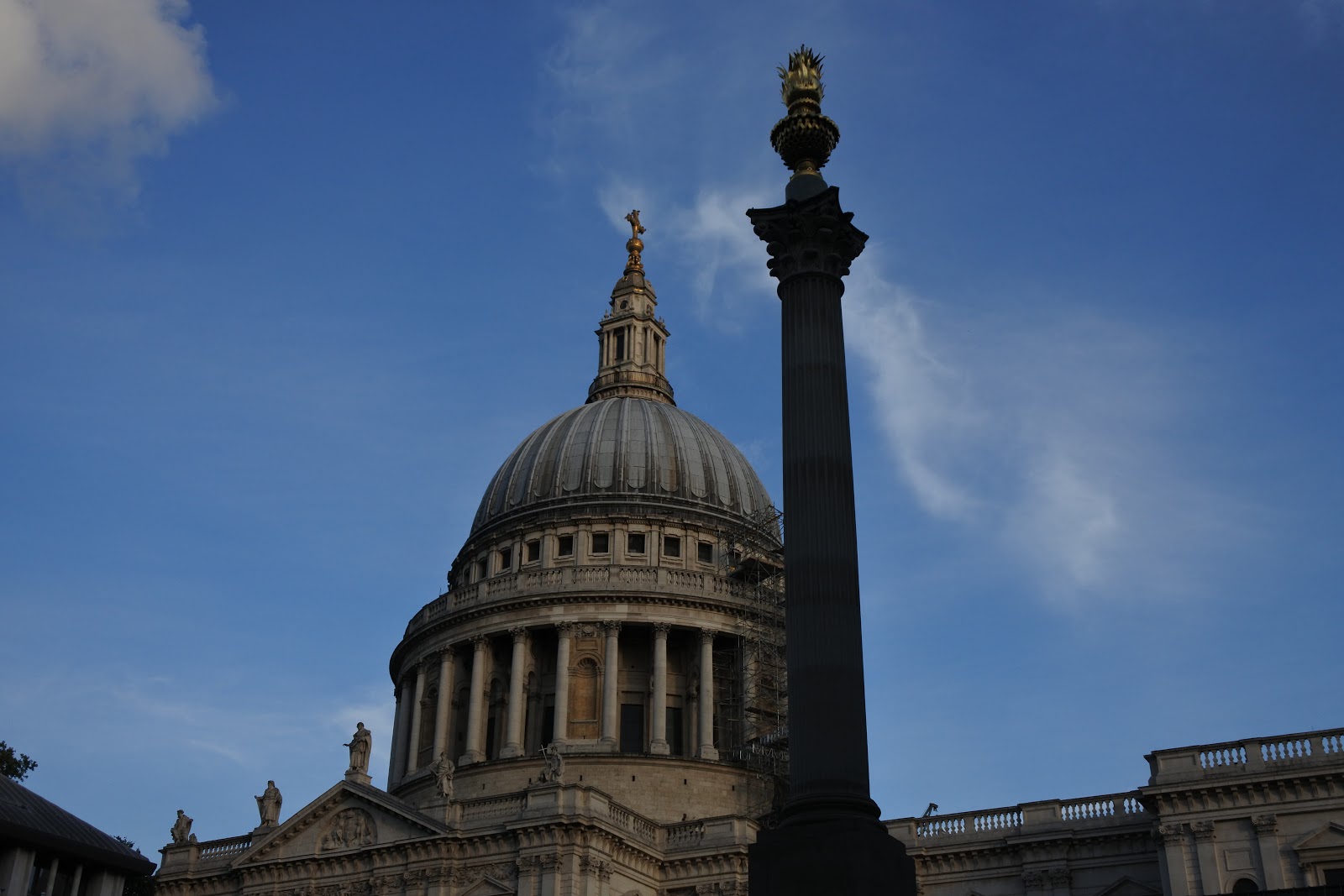
We would see more of London by walking tour and bus tour. We were warned months before we left that we should expect six to ten miles of walking each day. Really? That seems like a lot. But we did walk that much except for one day which I'll tell you about next time. In London we walked around St. Paul's Cathedral, Winchester Cathedral, Trafalgar Square, Leicester Square, and many other photogenic spots. My favorite was St. Paul's Cathedral, not only because Princess Diana got married there and I woke up very early that day to watch it on TV in New Jersey, but because during the Battle of Britain in 1940 when so much of London was destroyed and damaged, the gorgeous dome rose above the smoke unaltered. There's a famous black and white photograph of this scene, but I'll close with my own shots here.
Three shots of St Paul's Cathedral
And yes, we did hear the famous bells of St. Paul's:
Delaware's restored Fort Miles as seen from the Observation Tower with the Atlantic Ocean beyond
During World War II, it became apparent that we Americans should protect our factories and other industries from enemy attack. The Delaware Valley was home to many of these, including some vitally important to the war effort. Fort Miles was built on either side of the mouth of the bay in order to guard the Delaware River and Bay from enemy vessels that could blockade or sink our own. Cape Henlopen on the Delaware side had the bulk of the fort, but Cape May on the New Jersey side had some observation towers, a bunker, and personnel of its own.
Barracks Building A
The area became Cape Henlopen State Park after the war, and more recently the Delaware Division of Parks and Recreation has endeavored to preserve the surviving buildings of Fort Miles.The fort was listed on the National Register of Historic Places in April 2005.
The entrance to Fort Miles on Sandy Lane with the Observation Tower in the background
Fort Miles also has a large collection of "big guns" perched as they were in the 1940s ready to eliminate threats from enemy vessels.
Fred checks out one of the big guns at Fort Miles
Soldiers stationed inside the various
Inside the tower
Observation or Fire Towers kept watch on the Atlantic waters for enemy vessels. It is true that some German U-boats came very close to shore. (U-858 and its very young German crew were captured just off the coast at the end of the war and processed at Fort Miles.) The soldiers in the towers would communicate bearings to gunmen who used triangulation to figure how to aim those guns.
Visitors can climb the tower near the historic Fort Miles section for a stunning view of the park, ocean, beach, a couple of lighthouses, the Cape May-Lewes Ferry Terminal, and many ocean-going vessels.
One of the most remarkable things about Fort Miles and today's Cape Henlopen State Park is that it sits on top of a giant sand dune. It's labeled The Great Dune on my map and takes up 543 acres of the present-day park. The sandy soil and sparse vegetation create a desert ambiance charming for campers and beach-minded visitors, but how must this environment been for the soldiers of World War II?
The dune between Fort Miles and the Atlantic Ocean beach
Drive or bike along Cape Henlopen Drive, past the Cape May-Lewes Ferry Terminal, and bear to the right once inside the park to get to the restored Fort Miles area. Cape Henlopen also features swimming, camping, fishing, birding, and a nature center.