Showing posts with label Germany. Show all posts

Thursday, July 18, 2013

Memories of Old Heidelberg

Heidelberg Castle ruins
The writing prompt instructed me to choose three postcards that intrigue me. I sorted through my big box of postcards: some are filled with the travel memories of friends and family, and some memories are my own. I settled on a trio from Heidelberg, Germany.

A trio of postcards from Heidelberg

It has been almost five years since I was in Heidelberg with my sister.
The Great Tun     
It was one of the last stops we made on our German tour. We walked around the famous 15th- to 17th-century ruined castle, part of it only a facade wall, the Great Tun, a giant barrel which holds 58,000 US gallons of wine which reportedly had a direct line down to the city; and the Elisabethentor, an arched gateway built for a royal bride, and subject of one of my postcards.


The two other postcards take a step back to show the landscape. One, a borderless bird's eye view, shows the famous castle on the hill with the red-roofed old town below, and the Neckar River below that. A Roman-style arched viaduct transverses the river. A large tour boat has just passed under the bridge. Rising up from the old town is an enormous brown church. The second postcard, framed in black, shows Heidelberg Castle lit up at night with a light coating of snow.


A medieval section of the castle ruins

Heidelberg Castle is a hodgepodge of styles.
My camera was new and unfamiliar to me on that trip, but still my photographs reveal more of my sense of this place than my travel diary, and my little purchased travel guide fills in the history. There are the shots of the single facade wall with blue sky in the window openings. The castle was destroyed by the French Army during the War of the Grand Alliance (1689-93), and then further by lightning in 1764. Some of it was rebuilt, some not, so what results is a hodgepodge of Gothic, Renaissance, and Baroque architecture.

The Elisabeth Gate


Frederick V
The Elisabethentor, or Elisabeth Gate, was commissioned by Frederick V, the "Winter King," for his bride Elisabeth Stuart. She was the daughter of the English king. Frederick was called the "Winter King" because his kingdom lasted only slightly longer than a winter, and he ultimately died in exile. All of this happened in the early 17th century.

View from Heidelberg Castle garden
The castle garden provides a great view of the old town which came into existence around 1200. We had some free time to walk around the town where we saw newlyweds emerging from the city hall underneath red heart-shaped balloons.
Just married.
The large brown church turned out to be the Gothic Church of the Holy Spirit, begun in 1398. Between its exterior buttresses are unexpected little shops which date back to the 15th century.
See the brown church in the center? That's the Gothic Church of the Holy Spirit, begun in the 14th century.

Close-up of the Church of the Holy Spirit's new (17th-century) roof.

This trip predates my current obsession with bridges,so I didn't go out of my way to shoot it,
Carl Theodor Bridge, to the left.
but I still noticed the striking arched bridge that links the old town with the other side of the Neckar River. Its full name is the Carl Theodor Bridge, and was named after Prince Elector Carl Theodor who had it built of red sandstone to replace a flimsy wooden one damaged in a flood. This construction stretched from 1786-1788. On March 29, 1945, German soldiers blew up all of the Neckar River bridges, but the Carl Theodor Bridge was rebuilt by 1947.


Waffeln mit Schokosauce
Heidelberg was the only place in Germany where I had to attempt to speak German. We stopped for lunch at a cafe, both interested in the waffles with chocolate sauce advertised on a board outside. The waitress did not speak English, so I carefully ordered the waffles and water without bubbles for both of us.


My Heidelberg postcards are about to be filed away in their box until the next time I'm prompted to flip through them. My memories, however, stay with me. I would like to visit Heidelberg again, this time spending more time at the castle (perhaps touring the inside), and visiting Heidelberg University and its library. I wouldn't mind another serving of those waffles, either!


Sunday, October 12, 2008

Off to Berlin

We rode the superfast train from Cologne to Berlin. It took us only four hours to do what the bus needs twelve hours to do. It didn't seem all that fast, really, unless you try to focus on the ground right next to the track. The buildings and fields further away did not appear to be rushing past any faster than usual. Once at Berlin's mod new station, we were met by our local tour guide and bus. This station is huge with lots of stores and restaurants and lots of glass. (Enrico and our regular bus loaded with our luggage were taking the highway, and managed to meet us at the hotel after our tour.)


Our guide Christabel took us around Berlin and we stopped to visit some of the more interesting sites. First was the Kaiser Wilhelm church which was bombed during WWII. This facade to the right is really all that is left. A modern replacement church was built next to this sight, but the facade of the old church was left as a memorial to things lost in the war.


Eventually we made our way through the city to the Brandenburg Gate. Christabel led us through the center columns which used to be reserved for the kaiser! Finished in 1791, this is the only remaining gate of thirteen that used to stand on the perimeter of the city. Just past the gate is Unter den Lindens Avenue, a street with shops at one end and museums, libraries and performing arts centers at the other. I haven't figured out yet why the Old Library is known as the "Kommode".


It was hard to tell where the former East Berlin starts and West ends, except here by this remaining bit of the wall (below) and Checkpoint Charlie to the right. A lot of the guys from our tour gladly posed for photos in front of the famous checkpoint. The eastern part of the city has been working hard to catch up to the modern west side. I had to refer to my map to see exactly where our hotel sat.


This piece of the wall that wasn't torn down shows how impossible it would be to climb over. It's pretty igh for one thing, and that part that looks like a rubber bumper on top would keep a person from getting a grip good enough to hoist themself over. And then there are rows of barbed wire. Around the city, there are parts of the wall displayed showing the graffitied western side and the immaculate east side.


Finally after a long day of travelling and touring, we relaxed for awhile in our (East Berlin) hotel, a very modern, minimalist place called Moevenpick which is also the name of some German ice cream. This is the kind of place that leaves candy on your pillow. Since we were in Germany, the candy was Haribo Gummy Bears. This was a very fancy hotel by my standards, with a beautiful view out the window, and a bathroom wall made out of glass block. Although we were tempted to stay in that evening and put our feet up, we had signed up for a variety show at the Winter Garden Theater which turned out to be great fun.

Tuesday, September 30, 2008

Some Castles in Germany

THE RHINE CRUISE


Our first sightseeing excursion of the tour was a cruise on the Rhine River. There were castles, churches and towns on either side. The castles and castle ruins are the highlights, appearing one after another with little property surrounding them. (Eleventh-century Sooneck Castle is above, and Reichenstein Castle from 1192 is below.) These mostly anonymous medieval landowners were always jousting with their neighbors for more land.


SANSSOUCI


I've had this unread book on my shelf for 22 years that I bought in the 1980s after hearing a review on the radio. It's a biography of the non-anonymous Frederick the Great, King of Prussia. We music majors knew about Frederick because he was an excellent flutist and notable patron of the arts. We visited his palace on the tour, Sanssouci in Potsdam. Sanssouci means "without worries" and this palace became a headquarters for intellectuals and Frederick's sophisticated friends. Voltaire lived here for three years. Frederick's tomb is on the grounds, and visitors leave flowers and potatoes on it. Why potatoes? Because Frederick brought the plant to Germany to feed the hungry poor. He forgot to tell them right away that they were supposed to eat the bottom part of the plant. They were eating the leaves and not liking it very much.


CECILIENHOF


The other palace in Potsdam is Cecilienhof, where the Potsdam Conference starring Roosevelt, Churchill, and Stalin, and later Truman, Attlee, and Stalin, took place. It was in this palace that they signed the Potsdam Agreement after World War II.


LINDERHOF


Another superstar king was Ludwig II (sometimes referred to as Mad King Ludwig). He built

three famous iconic German castles, and we visited two on this tour. First, Linderhof with its man-made grotto and countless priceless porcelain vases. This castle, decorated in exaggerated Rococo style if tht's possible, features a waterfall fountain outside Ludwig's bedroom window. (see right.)


Linderhof's man-made Venus Grotto, a ten-minute walk up a steep hill, was a retreat for the king where he had his buddy Richard Wagner's opera, Tannhauser, performed while he floated around the man-made grotto lake in a boast shaped like a scallop shell. (Think Botticelli's "The Birth of Venus".)


NEUSCHWANSTEIN

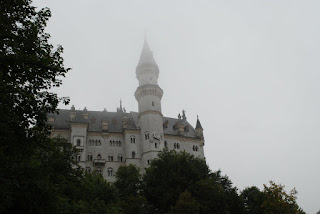
Ludwig's other famous castle, Neuschwanstein, also has a grotto inspired by the work of Richard Wagner, but it also features a bigger tribute. The singer's Hall, a fancy Rococo auditorium, is decorated with murals depicting scenes from Wagner's operas. Ludwig loved music and he loved reading: both of these castles feature upholstered reading nooks. This is the famous fairy tale castle that inspired Cinderella's place at Disneyworld. We missed out on the "money shot" photo of the castle because of clouds, but there were still plenty of photo opps on the property:

Sunday, September 28, 2008

Back from Germany!

There are things that make life wonderful, but those things are not the same for everyone. For me it has always been music, art, a good story, and good friends. In recent years it has become clear to me that travel is one of those things, too.


from the Rhine cruise: Ehrenfels Castle Ruin


I've just returned from a tour of Germany organized by professionals instead of by me, and I had a great time. I'm tired physically, but my mind is re-traveling to all these places, sorting them out and selecting the favorites. I never thought I would enjoy such a tour with the early wake-up calls and limited time at interesting sights, but I was wrong. We got to know almost all of the other 41 people on the tour, eating with different groups for breakfast and supper. We saw lots of sights and were kept on time by our amazing tour director Renske. I could never have planned such an interesting tour on my own, nor could I have stayed in such nice hotels. Renske told us some great stories from the history and culture of the various regions (one of my pillars of a beautiful life, remember). The food was great--either the hotel meals or the places we tried on our own. It was such a nice change to get my nose out of the travel guide and put the control in her (and Globus's) hands. Our excursions (included and optional alike) were planned efficiently around times they are least busy (and not closed for local holidays or renovation). This is stuff the average tourist wouldn't know.
(Furstenberg Ruin 1219)


The transportation was always figured out for us whether it was by bus, boat, or train. Our amazing driver Enrico took us through cities and mountains, and down hundreds of miles of highway, making it look easy all the time. He had the responsibility of loading our luggage on the bus almost everyday, and I know first hand some of those bags are HEAVY.


Rhine River tour boat


So I'm a changed person. Tours are now an official kind of travel, one of my five pillars of beauty in life. Now it is my task to sort through my just-under-one-thousand photos and sort out all of the castles, churches, towns, cities, markets, and statues we saw!


Flower stand in Munich


East Berlin