Saint Agnes's Catholic Church was our first, just across from the Cape May Point General Store. This Carpenter-Gothic style church was built around 1885. It was expecting an early afternoon wedding luckily for us, so we were able to peek inside at the gorgeous stained glass.
Sunday, November 13, 2011
The Charming Churches of Cape May Point
We wandered around Cape May Point yesterday, a bright, sunny, dry and windy day. I called it a perfect kite-flying day, but the clerk at the hardware store called it a perfect exterior painting day. Both of of us turned out to be
correct according to to evidence presented by the citizens of Cape May Point. They were flying kites and painting fences, riding bikes and raking leaves. We carried Joe Jordan's book, Cape May Point: Three Walking Tours of Historic Cottages, but only for reference. We agreed to go in search of Cape May Point's churches, picking and choosing parts of the three tours in the book.
Saint Agnes's Catholic Church was our first, just across from the Cape May Point General Store. This Carpenter-Gothic style church was built around 1885. It was expecting an early afternoon wedding luckily for us, so we were able to peek inside at the gorgeous stained glass.
The Beadle Memorial Presbyterian Church is just across from St. Agnes on Cape Avenue. Its namesake, Rev. Beadle, was John Wanamaker's pastor back home in Philadelphia at the First Presbyterian Church there (21st and Walnut Streets). Yes, that is the same John Wanamaker from department store fame--he was an early resident of Cape May Point! Beadle Memorial was built around 1882 in the Stick style popular then. It was moved twice (in 1920 and 1966) before landing in its present location, because the of the encroaching pre-duned ocean. Many of the buildings in Cape May Point used to be at different locations but many others were lost to storms and flooding. The Joe Jordan book has some vintage photos of some of these lost Victorian beauties.
Another Stick-style church, St. Peter's-by-the-Sea, is probably the most-photographed building in Cape May Point. This church was purchased from the 1876 Centennial Exhibition in Philadelphia, disassembled, moved to Cape May Point, assembled at another location, and finally moved to this triangular, picket-fenced site. Fred chatted-up the guy painting the picket fence supports yesterday (it was a perfect day for that kind of thing).
St. Peter's Beach is just across from the church, and is one of the hot birding spots in Cape May Point which is in itself a really hot birding spot, globally speaking. I had to veer off the church tour to peak at the ocean.
Union Chapel was the last church we visited. This is not the original non-denominational Union Chapel, but was built around 1900. I'm not sure what "soaking" is, but signs were attempting to entice us to one. We resisted.
Lastly, the iconic St. Mary's-by-the-Sea, purchased for $9,000 for the Sisters of St. Joseph around the turn of last century. Originally, this was the swank Shoreham Hotel. When the nuns took over, the Shoreham's ballroom was changed into a chapel and the building's name was changed to St. Mary's-by-the-Sea. This was to honor the priest from St. Mary's in Philadelphia who facilitated the purchase.
When our walking was finished, we stopped to rest at Lake Lily, the centerpiece of Cape May Point, and yet another hot birding spot.
Saint Agnes's Catholic Church was our first, just across from the Cape May Point General Store. This Carpenter-Gothic style church was built around 1885. It was expecting an early afternoon wedding luckily for us, so we were able to peek inside at the gorgeous stained glass.
Sunday, October 16, 2011
"What's in it for Me?": Formulating a Pre-Holiday Shopping Strategy
It is a truth universally acknowledged that when the weather turns crispy, the nostalgic, holiday-inspired, travel writer's thoughts turn to her favorite pre-holiday hang-out. Of course mine is Cape May. I've written before how the Dickensian Christmas there tends to shape up just after Thanksgiving to fill me with holiday joy. This is around the same time that my busy fall schedule starts to relax and permit me to enjoy the season there. This year--and this is the 'takeaway' from this post--I've been planning my end-of-year gift shopping strategy. (Note: I've linked to a bunch of websites here, so if the text is a different color, click on it!)
1.
2. Jersey Shore Alpacas. This little alpaca farm just north of Cape May is run by Jim and Tish
3. The W
4. So maybe you can't get to Cape May, or perhaps you'd like a gift reminiscent of America's Original Seaside Resort. Maybe you'd like some Cape May themed note cards? Handmade by me? With my own photos? Go ahead and visit my Etsy shop...no pressure...new stuff is added as I get inspiration or replenish my supply of glue dots. If you missed it, the link is here.
Labels:
alpacas,
Cape May,
Jersey Shore Alpacas,
shopping,
speaking,
West End Garage
Saturday, September 17, 2011
Beethoven, My Travel Companion
A major part of traveling is the getting there and the getting
home. I select books carefully if someone else is doing the driving (or flying), and when I'm the driver I give thought to what is tuned in on the radio or inserted into the CD player. The recent drive home from the beach at the end of Labor Day weekend was bittersweet--the end of the summer season and all--but my classical station was finishing the much-anticipated Classical Countdown, or its top 30 listener requests. Beethoven's Ninth Symphony won the top spot.
My MINI Cooper has a great sound system and I often imagine myself in this bubble of high-fidelity moving through space. No. 9 never sounded so good as it did that day in all its layers and textures and contrasting movements. This may sound goofy, but that old favorite piece of musical genius sang to my melancholy soul. The third movement, the slow one, in particular seemed to take over my consciousness. This experience of full engagement in over seventy minutes of Beethoven caused me to think about his role in my life journey so far. From what I've read, I probably would not have liked the man very much, but his music is a touchstone for me.
As a Music Theory major in Music History class, I remember having the nicest professor for the one semester out of the four that we studied the Classical Era. Medieval/Renaissance, Baroque, and Romantic/20th Century were tough.
We endured bitter professors who displayed no passion for the subject matter and inspired us to rename those courses 'Music Misery.' I'm here to tell you, umpteen years later, their intimidating, no-nonsense approach was not any more effective than the kind and gentle professor. Having that sweet, knowledgeable Dr. Meyer guide us through the music of Haydn, Mozart, Beethoven, and their contemporaries was pure joy. Lesson learned.
In graduate school for Music Theory, we focused more on form and interpretation than individual chords and themes. Dr. Archibald blew the roof off the place when he performed Beethoven's "Waldstein" Sonata (Op. 53) for us in class. This might have been the single most inspirational moment of any of my Music Theory classes. I sat in awe as we dissected the piece after that, labeling the chords, themes and sections of the piece and talking about what was going on in Beethoven's life when he was composing it. Wow. Dr. Archibald was also my thesis advisor. I chose Beethoven's Quintet for Winds, Op. 16, an early work, because there wasn't much scholarship on it yet. I worked for two semesters on that piece analyzing every second of it. I'll never forget Dr. Archibald coaching me to consider the piece of music, and my analysis, as an organic thing growing in time. True that.
That musical education I put so much time into attaining is usually packed away with utmost care in some storage area of my brain. The experience of the Ninth Symphony in the car caused me to go rifling through my books, scores, and notebooks to reminisce about my glory days as a music theory student. The hearing of the Ninth Symphony encouraged me to do some reading which reminded me how Beethoven was a master at using themes and motifs to create impressions. He called himself a 'tone poet' (Tondichter in his own German). His music did not tell a story literally, but these impressions emerge as fanfares and pastoral moments with foreshadowings, reminiscences, and developments of these moments to create form. The impression you get from your listening of the Ninth Symphony will differ from mine just as von Karajan's recorded interpretation will differ from Muti's. It may be simply an aurally pleasing succession of sounds to us, or it could tell us a story. Wilhelm von Lenz wrote that the story told by No. 9 is the history of the universe with the first movement representing Creation. Could be. One thing is sure even to anyone who doesn't understand German or read music: the symphony is an incredible seventy-plus-minute journey to a joyful destination.
home. I select books carefully if someone else is doing the driving (or flying), and when I'm the driver I give thought to what is tuned in on the radio or inserted into the CD player. The recent drive home from the beach at the end of Labor Day weekend was bittersweet--the end of the summer season and all--but my classical station was finishing the much-anticipated Classical Countdown, or its top 30 listener requests. Beethoven's Ninth Symphony won the top spot.My MINI Cooper has a great sound system and I often imagine myself in this bubble of high-fidelity moving through space. No. 9 never sounded so good as it did that day in all its layers and textures and contrasting movements. This may sound goofy, but that old favorite piece of musical genius sang to my melancholy soul. The third movement, the slow one, in particular seemed to take over my consciousness. This experience of full engagement in over seventy minutes of Beethoven caused me to think about his role in my life journey so far. From what I've read, I probably would not have liked the man very much, but his music is a touchstone for me.
As a Music Theory major in Music History class, I remember having the nicest professor for the one semester out of the four that we studied the Classical Era. Medieval/Renaissance, Baroque, and Romantic/20th Century were tough.
We endured bitter professors who displayed no passion for the subject matter and inspired us to rename those courses 'Music Misery.' I'm here to tell you, umpteen years later, their intimidating, no-nonsense approach was not any more effective than the kind and gentle professor. Having that sweet, knowledgeable Dr. Meyer guide us through the music of Haydn, Mozart, Beethoven, and their contemporaries was pure joy. Lesson learned.In graduate school for Music Theory, we focused more on form and interpretation than individual chords and themes. Dr. Archibald blew the roof off the place when he performed Beethoven's "Waldstein" Sonata (Op. 53) for us in class. This might have been the single most inspirational moment of any of my Music Theory classes. I sat in awe as we dissected the piece after that, labeling the chords, themes and sections of the piece and talking about what was going on in Beethoven's life when he was composing it. Wow. Dr. Archibald was also my thesis advisor. I chose Beethoven's Quintet for Winds, Op. 16, an early work, because there wasn't much scholarship on it yet. I worked for two semesters on that piece analyzing every second of it. I'll never forget Dr. Archibald coaching me to consider the piece of music, and my analysis, as an organic thing growing in time. True that.
That musical education I put so much time into attaining is usually packed away with utmost care in some storage area of my brain. The experience of the Ninth Symphony in the car caused me to go rifling through my books, scores, and notebooks to reminisce about my glory days as a music theory student. The hearing of the Ninth Symphony encouraged me to do some reading which reminded me how Beethoven was a master at using themes and motifs to create impressions. He called himself a 'tone poet' (Tondichter in his own German). His music did not tell a story literally, but these impressions emerge as fanfares and pastoral moments with foreshadowings, reminiscences, and developments of these moments to create form. The impression you get from your listening of the Ninth Symphony will differ from mine just as von Karajan's recorded interpretation will differ from Muti's. It may be simply an aurally pleasing succession of sounds to us, or it could tell us a story. Wilhelm von Lenz wrote that the story told by No. 9 is the history of the universe with the first movement representing Creation. Could be. One thing is sure even to anyone who doesn't understand German or read music: the symphony is an incredible seventy-plus-minute journey to a joyful destination.
Labels:
Beethoven,
classical music,
journeys,
music theory,
Ninth Symphony,
traveling
Sunday, July 24, 2011
Two Busy Weeks in Cape May
My recent two-week vacation was packed with more action than usual but at the same time I actually attained relaxation. I had planned a reading and writing vacation and brought a few stacks of books and notebooks. My main writing would be for nj.com's Jersey Shore Blog. I'm contributing there about extreme South Jersey (i.e. Cape May, Wildwood, and points inland) just for the summer season. Therefore, I'd have to experience some adventures so I'd have plenty to write about for the agreed-upon twice-a-week posts.
On my first day, I took a whale watching cruise out of Cape May. I've done this before and only ever seen dolphins, so I was set to write a nice little post about those Atlantic Bottlenose scamps. To my surprise, the captain announced that there were three humpback whales sighted about eleven miles out and we were headed right for them. I'd seen whales off Bar Harbor, Maine, and San Diego, California, but never off the coast of Cape May! But there was one right in front of our boat, spouting and diving, and I got some great whale's tail photos. It was magnificent. Read about that cruise here.

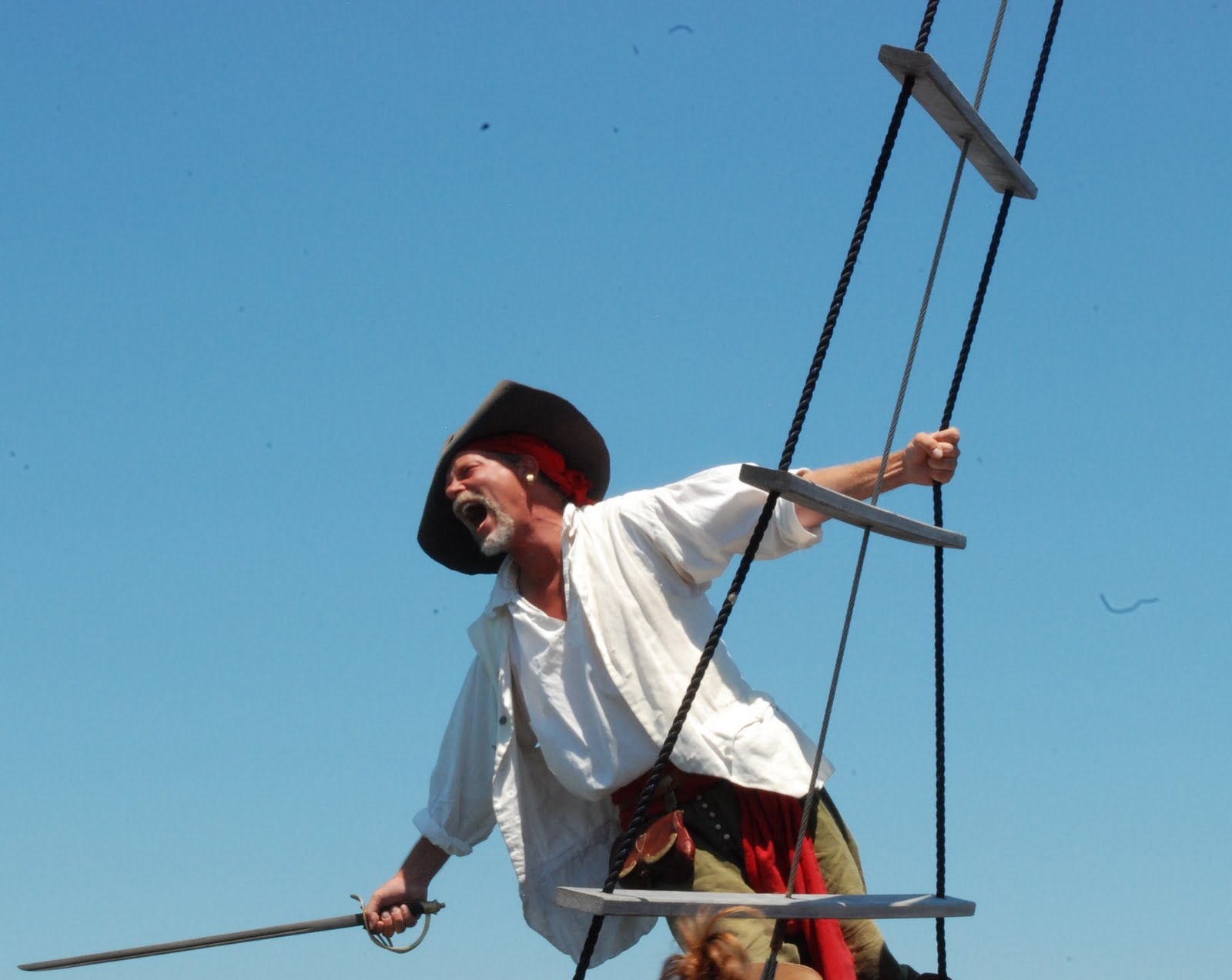
I like boats and I'll take any excuse to ride on one. I also like pirates. We set sail on Wildwood's Dark Star Pirate Cruise on the last day of vacay. Fred and I were the only adults not accompanied by kids, but we had a fabulous time. Those pirates maintained the action and the interest for the entire hour. We learned some pirate jokes, pirate lingo, pirate history, hauled some treasure aboard, and we got to engage in a firefight (actually water) with another pirate ship. I posted about that here.
In-between the whales and the pirates, I explored Cape May. As a lifetime part-time resident, I know this place well, but I always learn new things on these (Cape May Mid-Atlantic Center for the Arts and Humanities) tours. During these two weeks, I toured East Cape May to see the mansions by the sea,
West Cape May to learn about its farms and history, the iconic Victorian architecture including Show allthe Physick Estate,
the U.S. Coast Guard Training Center (including the Sunset Parade), the 2011 Designer Show House (this year on the century-old Cape May Harbor), and I had a seat on the Ghosts of the Lighthouse Trolley Tour. Ghosts are really big this year (in New Orleans, too), so I had to sample a piece of Cape May's paranormal offerings. This tour included a nighttime climb of the lighthouse, another first for me. I have or will post about all of these things on that nj.com blog, along with some local farmers' markets and the Ocean Drive. What a fun experience that has been, and I still have over a month of posts left to dream up.
There were two excursions during this vacation that required some mileage and some decent outfits: a very pleasant al fresco dinner party with friends, and a book talk and signing at the Avalon Public Library. I just happened to notice an ad for this in the newspaper, but people I spoke to at the event had been looking forward to it for months. David and Julie Nixon Eisenhower spoke about themselves, their families, and their new book, Going Home to Glory, about Dwight D. Eisenhower's post-presidential years (1961-1969). I had the opportunity to chat with Julie Nixon Eisenhower, and found her quite witty and charming. They were headed to Cape May after the talk, and when she asked me how long it would take to get there, I had the answer: 27 minutes.

Even with all of these adventures, I had to be sure to squeeze in my favorite activity, the beach! I made it to my three favorites, the Cape May Point State Park beach, the Delaware Bay Beach (with Gladys), and the ocean beach at Jackson Street. A Cape May vacation can be so much more than just the beach, though! I hope you will click on some of the links above to get a sample of how I'm keeping myself busy this summer!
I like boats and I'll take any excuse to ride on one. I also like pirates. We set sail on Wildwood's Dark Star Pirate Cruise on the last day of vacay. Fred and I were the only adults not accompanied by kids, but we had a fabulous time. Those pirates maintained the action and the interest for the entire hour. We learned some pirate jokes, pirate lingo, pirate history, hauled some treasure aboard, and we got to engage in a firefight (actually water) with another pirate ship. I posted about that here.
In-between the whales and the pirates, I explored Cape May. As a lifetime part-time resident, I know this place well, but I always learn new things on these (Cape May Mid-Atlantic Center for the Arts and Humanities) tours. During these two weeks, I toured East Cape May to see the mansions by the sea,
There were two excursions during this vacation that required some mileage and some decent outfits: a very pleasant al fresco dinner party with friends, and a book talk and signing at the Avalon Public Library. I just happened to notice an ad for this in the newspaper, but people I spoke to at the event had been looking forward to it for months. David and Julie Nixon Eisenhower spoke about themselves, their families, and their new book, Going Home to Glory, about Dwight D. Eisenhower's post-presidential years (1961-1969). I had the opportunity to chat with Julie Nixon Eisenhower, and found her quite witty and charming. They were headed to Cape May after the talk, and when she asked me how long it would take to get there, I had the answer: 27 minutes.
Even with all of these adventures, I had to be sure to squeeze in my favorite activity, the beach! I made it to my three favorites, the Cape May Point State Park beach, the Delaware Bay Beach (with Gladys), and the ocean beach at Jackson Street. A Cape May vacation can be so much more than just the beach, though! I hope you will click on some of the links above to get a sample of how I'm keeping myself busy this summer!
Labels:
beach,
blogging,
Cape May,
North Wildwood,
pirates,
Victorian architecture,
whale watching
Monday, July 4, 2011
Perfecting our Saunter at Three Louisiana Sugar Palaces
First on the agenda was Laura, a Creole plantation built in 1805 in Vacherie, Louisiana. The tour through the house and grounds was fantastic and we felt the most authentic of the three we'd see. We learned that these houses are supported by huge underground pyramids of bricks because the earth is so soft and wet. The house is painted in traditional Creole colors which set it apart from the white Greek Revival mansions we would see next.
Another unusual fact about Laura is that since its owners were of French descent, the
It's also interesting to learn that the folktales told by the Senegalese slaves at Laura were recorded by a Louisiana State University professor and eventually became known as the B'rer Rabbit tales.
Our third plantation visit was Houmas House in Burnside, Louisiana. This one gets the priz
Thursday, June 30, 2011
New Orleans Spooks Margaret (Part 2)
"Visitors staying in this hotel would go home, have their film developed, and find pictures of themselves sleeping in their beds...taken from the ceiling!"
I heard this ghost story and many other convincing tales on the New Orleans Spirit Tours Ghost and Vampire Tour. The visitors mentioned above were staying in the Andrew Jackson Inn which at one time was a boarding school for boys. There was a fire in which some of the students perished, and these became the mischievous photographers who also noisily haunt the halls.
Like me, our tour guide, George, is skeptical about the existence of vampires. Thanks to recent movies and television shows, vampires are a big, big topic in New Orleans. Believer or not, George had some interesting stories about them. One tale describes a mysterious and dashing man-about-town from last century who suddenly disappeared. When his New Orleans social set researched his name, they found that it matched another character from generations before in Europe. The two men even matched the same description
Whether or not vampires really exist (I hope not), there does exist a community of wanna-bees who hang out in clubs like the Dungeon, just off Bourbon Street. Walking past this establishment, even in the daytime when it was closed, gave me the willies. (It was also uncomfortably close to my own hotel.)
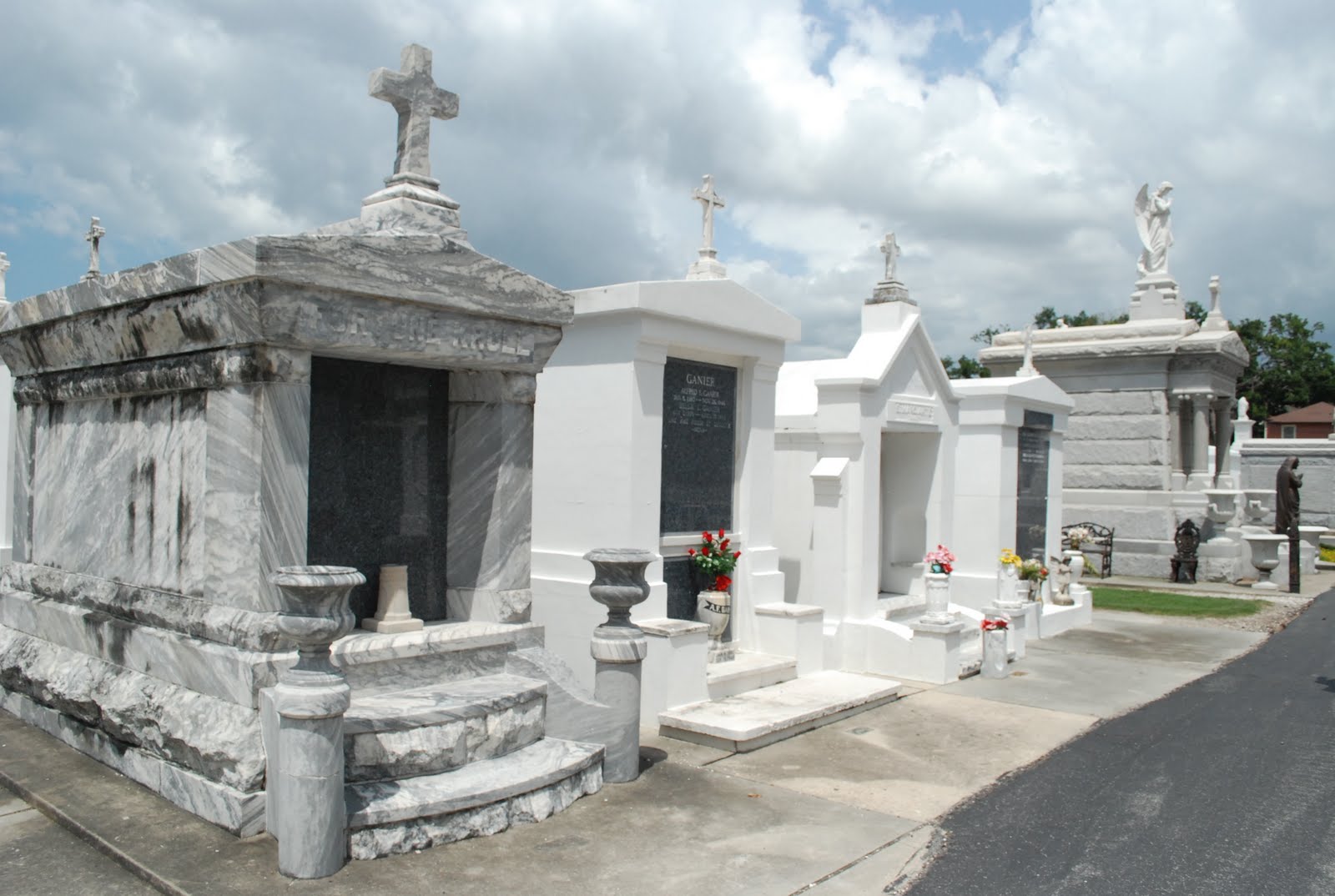
Ghosts and vampires may or may not exist, but one piece of New Orleans culture might be the most chilling of all. In the cemeteries, bodies are buried above ground because of the high water table. These family t
Labels:
cemeteries,
ghosts,
New Orleans,
tombs,
vampires
Wednesday, June 29, 2011
New Orleans Captivates Margaret, (Part 1)
Sitting on the airplane, catching up on my journal, I realized I would have to limit my New Orleans posts to the sights and experiences that I found the most interesting. It might seem strange to pair a cathedral with street jazz musicians, and then mention piles of powdered sugar with doughnuts underneath, but these are the big surprises of New Orleans. We did visit the famous Bourbon Street, a few times, but it was close to what I expected. I intend to concentrate here on the delightful surprises.
The Cathedral-Basilica of Saint Louis, King of France, sits just north of Jackson Square in the French Quarter. Taken from pretty Jackson Square, almost any photo of the cathedral will have Crepe Myrtle, magnolia, and palm trees in the foreground. I couldn't resist taking a few photos of the Spanish-style cathedral, but I hadn't planned on entering until (of all people) our ghost-and-vampire tourguide advised us not to miss it. It might have been partly the turbo air-conditioning on a beastly-hot day, but to me, the cathedral w
I expected to find jazz musicians on the streets of the French Quarter, but I did not expect them to be so good! Almost every block had some unusual combination of instruments playing technically-virtuosic, heartfelt, and intense jazz. My favorite, just down the street from Aunt Sally's Pralines, was a clarinet player endowed with the technical prowess of Benny Goodman jamming with an equally accomplished trombonist. They were playing in a Dixieland style. As a longtime clarinetist who has enjoyed many friendships with trombonists over the years, I appreciated this combination. Music is after all, a
On the other side of Jackson Square is the famous Cafe du Monde. I couldn't get near this place until my last day in New Orleans because it was so crowded. Finally after our city tour, Linda and I popped in f
Labels:
beignets,
Cafe du Monde,
French Quarter,
jazz,
New Orleans,
Saint Louis Cathedral
Subscribe to:
Posts (Atom)