Saturday, January 9, 2016

Mallards & Buffleheads & Goldeneyes

The lake trail (with some other guy and his sweatered bulldog up ahead)
Good Morning, Readers. Fred and Gladys and I have been walking in the Hamilton-Trenton Marsh lately, not as a formal New Year's exercise resolution, but just 'because'. One of these days I will remember to set the pedometer app to measure the walk, but I estimate that it is about two miles: from the house, around the corner, down the hill, around the lake, up the hill, and back home. This post is more pictorial than literary, and I hope you will have the sensation that you came along with us but without the ever-so-slight ache in your calves. BTW, this area is also known as John Roebling Park, Spring Lake, and most recently, Abbott Marshlands.

Beaver architecture, ca. 2016
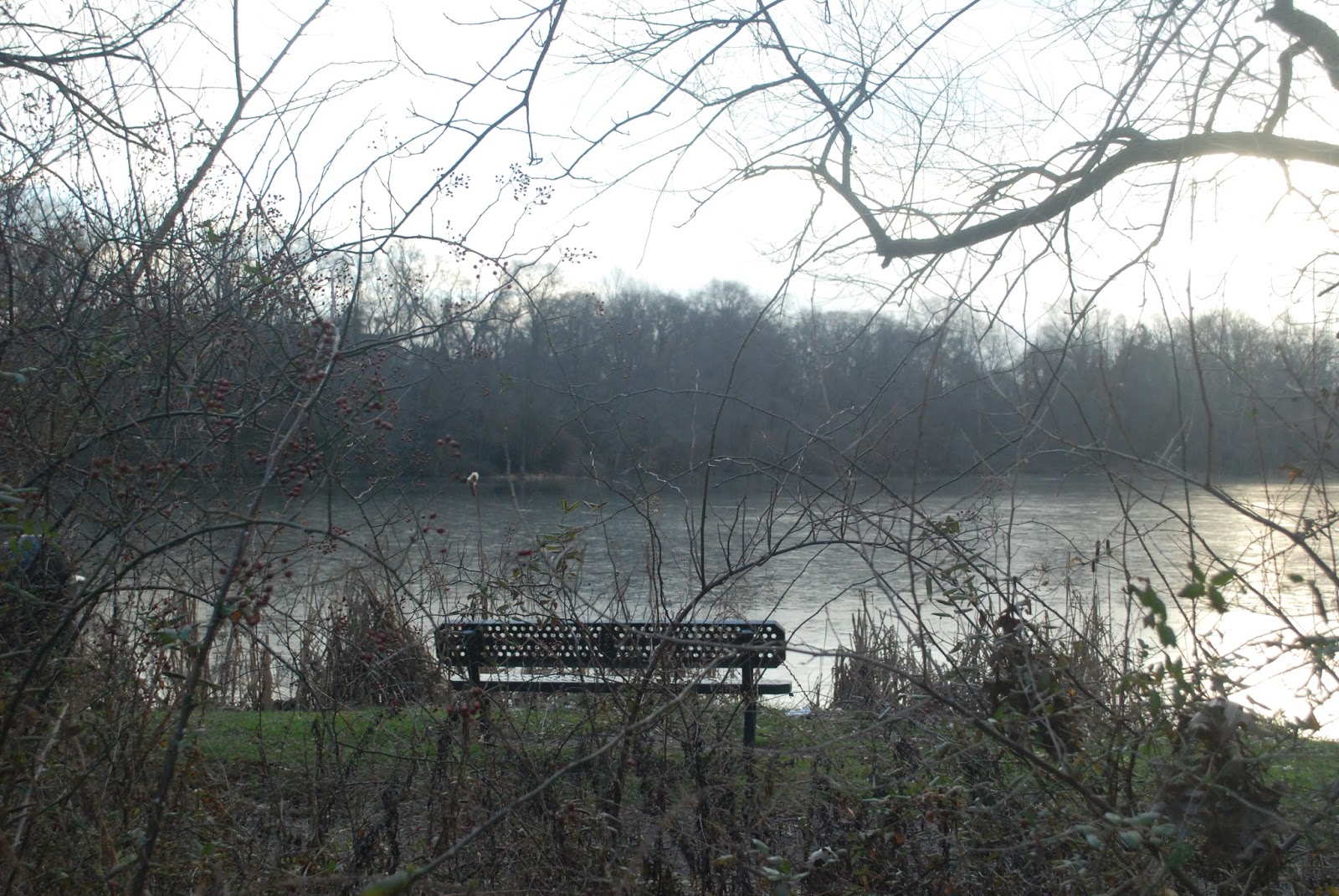
This is Spring Lake
Action shot: Gladys loves the Marsh!
Tree down! This tree always dreamed of being a dock.
Water Snakes: usually I don't see these.

ROOTS...


AND BERRIES...


and BIRDS:

Look between the Phragmites to see the Mallard
Goldeneyes? Buffleheads? I think I saw some of each, but I walked away without good evidence.
The soundtrack of our walk was provided by these noisy Canada Geese.
As you can see by our walk, there's plenty of life being lived in the winter marsh. I'm not 100% sure that my bird identifications are 100% correct, but I did my best post-walk research with my Peterson and Kaufman bird guides. It is a truth universally acknowledged by birders that birds in the wild do not stand still to pose for photographers or amateur birders. What fun would it be if they did?

Sunday, December 13, 2015

Salzburg


I've realized that I haven't finished telling you about the destinations we visited on the Danube river cruise. I've been distracted by some very big and very wonderful projects of the writing, teaching, and learning variety. There will be more to come on these endeavors, but for now, I thought you'd like to take a trip with me to Salzburg. This is the city of W.A. Mozart's birth, and it is where "The Sound of Music" takes place. Both of these are evident all over town, but Salzburg has some other distinctions, too.

If you're thinking that Salzburg is not actually on the Danube River, so Margaret must be confused about where she went on her trip, you would be partially correct. Our ship docked in Linz (home of the flannel nightgowns, truffles, and more cathedrals), and we took a bus to Salzburg. On the way we passed Mondsee, a lovely, picturesque town where Maria von Trapp's actual wedding church is. (I caught a glimpse of the church's exterior from the bus, but not a photo.) The centerpiece of town is actually the serene lake, seen below, shot from a rest stop...


Mondsee

Our tour through crowded Salzburg (possibly the most crowded city on our itinerary) combined some Sound-of-Music sites, some Mozart sites, the cathedral because there's always a cathedral and this one starred in a movie, and some notable shopping spots.


Signs


Pretzels

Flower Market


Fruit Stand


SALZBURG CATHEDRAL
Our tour guide made the obligatory Central European cathedral more interesting by telling us that if we found the right spot just outside the gate, it looks like those two angels up there are placing a gold crown on the Blessed Mother's head. I took that as a photo challenge and found the spot:


Salzburg Cathedral

Just around the corner from the cathedral is an enormous golden ball with a man standing on top. Is the man taking in Salzburg scenery? Not sure what he's doing up there.
We'll see this golden sphere again.


MOZART'S HOMETOWN
Speaking of spheres, Salzburg is the home of those little candies with Mozart's picture on them, ubiquitous in Central Europe. Mozartkugel is the official name, but they are known as Mozart balls in the vernacular. These were first made in Salzburg in 1890 by the candymaker Paul Fürst. He covered marzipan and nougat in chocolate and added a silver wrapper with Mozart's picture. These are the originals and they are still available in Salzburg, but there is also a copy in a red wrapper available all over Europe and even the USA.


Mozart Ball Shop


We had free time after the tour: quick! Decide what would be the most interesting thing! Use your free time wisely! Most people who know me and read me would probably predict that I would choose Mozart's birthplace. It is now a museum and located conveniently in the center of town.


Mozart's birthplace


HOHENSALZBURG

Of course I would have liked to visit this house, but I was more intrigued by the huge medieval structure on the top of the hill known as Hohensalzburg.


Here, Hohensalzburg looms over the Mirabell Gardens where Maria and the von Trapp kids sang "Do Re Mi." Hohensalzburg is a 900+ year-old fortress and castle which sits on a plateau and supplies some astonishing views of the city. I wonder how different the view from up there looked in 1077, when construction began on the first building. Those medieval folks would have had to climb up to the fortress on foot, but today visitors can ride up on the Funicular which has been in place since 1892. I'll admit that was part of the attraction of this attraction for me. The fortress has been open to curious tourists since 1861 when Emperor Franz Josef realized it was no longer needed as a military fortress.
Steep Funicular tracks


Once up there on the fortress's plateau, I enjoyed a lovely cafe lunch of Turkey Schnitzel (Austrians put all kinds of stuff inside schnitzel!) and a refreshing Diet Coke. It was rather warm that day.


Here's the cafe atop Hohensalzburg.


The views from Hohensalzburg were almost enough to distract me from the edifice I was visiting. There's the center of town and there's the salty Salz River from which the city gets its name. (I brought some Salzburg salt home for some people who can never seem to get enough salt.)


Salzburg's Old Town: Cathedral, golden ball, Chapter Square


Salzburg: St. Peter's Abbey and the Salz River


It was Archbishop Gebhardt von Helffenstein who began construction on Hohensalzburg in 1077, but Prince-Archbishop Leonhard von Keutschach (1495-1519) who made the place comfy in a luxurious kind of way. The state apartments here were his oasis from the people of Salzburg who mocked his love of books over farming. (Yes, the state apartments included a library.) Salzburg citizens disliked Keutschach so much they threw turnips at him. He had the last laugh, because he included a turnip in his coat of arms.

I'll end with some shots from Hohensalzburg because I have to go catch the big bus back to the ship!


It's a steep climb to see inside.

This is how I take a selfie.


I'm pretty sure that's the Trumpeter's Tower.


Monday, July 27, 2015

Germany's Three-Rivers City: PASSAU

From the ship, across the green Danube in Passau, Germany
 Passau was the final stop on our whirlwind "Danube Waltz" river cruise, and frankly, since I'd never heard of it I figured it was just a convenient spot to disembark and head the the airport or jump on a bus to Prague. I was WRONG. Passau was a lovely town with a long history and beautiful Baroque buildings. I took many photos on our walking tour, starting with this one to show how close the ship pulls up to the town:
This was taken from the ship--we're almost downtown!
Passau's location at the confluence of three rivers makes it unique among Danube River cities and towns, and also put it on the map before there were maps. I took this shot of a postcard I bought showing Passau and it's three rivers, the Danube, the Ilz, and the Inn.
The centerpiece of town is yet another St. Stephen's Cathedral. Of course it is gorgeous, but it has a musical significance: the largest cathedral organ in the world! Actually, it is made up of five separate organs which can be combined from either of two consoles, one with five manuals (keyboards) or one with four. Each of these organs has a distinctive sound: the "Gospel" organ has a French organ sound, the "Epistle" organ has a South Italian Baroque sound, the choir organ sounds North German, and the Fernwerk organ sounds like an echo because the sound comes to the congregants through grates in the ceiling commonly known as "Holy Spirit Holes." Ha. The fifth organ is the main one which can sound any way it wants to because it is connected to the others through cables. We were able to attend a 30-minute concert, and I'm here to tell you that was a memorable experience! The organist, Bastian Fuchs, displayed the colors and timbres of that instrument by playing works of John Stanley, JS Bach, Percy Whitlock, Alexandre Guilmant, and Charles Marie Widor, roughly in chronological order. They could probably hear the concert over in Prague without any amplification.
Here are some of the 17,000 pipes.
And in case you are curious, and can't get there at noon in the summertime for a 30-minute concert, here are some Reger tunes for you:

The church is one of the most beautiful we'd seen in the cities and towns on the Danube. I know you are wondering why the cathedral looks Italian Baroque, and I've already mentioned that Passau has a long history stretching back beyond the Middle Ages. This is because there was a huge fire in 1662 which burned the whole town. When the people rebuilt the town, they followed the prevailing style which was Italian Baroque, and if I'm not mistaken, I think I read somewhere that they hired some Italian architects and builders to help out.

More views of St. Stephen's:

The front of St. Stephen's Cathedral

The gilt pulpit dates from 1720
An unusual sundial in the courtyard--can you figure out how it works? (Hint: look at the window above the painted braid.)

Facing the sundial in the courtyard is a display of grave markers. After your descendants aren't around to pay for the upkeep of your grave or tomb, your bones are moved elsewhere and your marker, if distinctive, is kept on display. This makes room for new arrivals in the crypt.
An ancestor of Captain Georg von Trapp had a marker made to look like a locket.
I have to admit that when I was there, I missed what the tour guide said this next building was. We wore earpieces for every tour where we'd hear our own guide talking about the sites, but if we strayed to far, we'd lose contact. Chances are I paused to snap a few photos and didn't hear her say that this lovely building is the Neue Residenz, or the New Residence for the prince bishops since 1730. (This why I purchase a little booklet of each city's sites while I'm there: "OH! That's what I saw!!")
The Neue Residenz, 1730

The Baroque staircase in this building was to-die-for elegant, but not easy to photograph.
The famous Baroque staircase in the Neue Residenz
I didn't get any photos of the Rathaus, or Old Town Hall, because I was too close to it and never caught sight of it from a distance. (Does that make sense?) But we did see a bride and groom coming out of it (in Germany the real marriage takes place in the Rathaus in regular clothes, sometimes during the week, and the big celebration with white dresses, etc. happens later.)
A newly-married couple attracting attention at the Rathaus
Just above where the bride was standing is the town's flood record (i.e. water levels)
Passau's second most-photographed building is probably the "Veste Oberhaus," a fortress or citadel which sits at the confluence of the Ilz and Danube rivers. It was begun in 1499, or at least that is the visible date on the outside (the fish standing on its tail is a 4), but it was a work-in-progress for centuries. Today, it houses a youth hostel, museum, and popular tourist vantage point.
Veste Oberhaus from across the Danube
The artists of Passau and I don't want you to think that everything is old. There is an active art scene here, centered at Artists' Alley. This is one of those narrow, cobble-stoned, medieval alleys you find sometimes in really old European cities. But look up! Are those umbrellas hanging there? A tough of 21st-century whimsy.
Art Alley
More of Art Alley with red and white cobblestones marking your path
Some of Art Alley's cool umbrellas
Passau is an old town and contains many narrow alleys and streets. These add to the town's charm...

...and the downhill alleys (which I don't want to even imagine in winter) lead us back to the Danube and our ship...
(That's not us. Those are models.)