Sunday, July 24, 2011

Two Busy Weeks in Cape May

My recent two-week vacation was packed with more action than usual but at the same time I actually attained relaxation. I had planned a reading and writing vacation and brought a few stacks of books and notebooks. My main writing would be for nj.com's Jersey Shore Blog. I'm contributing there about extreme South Jersey (i.e. Cape May, Wildwood, and points inland) just for the summer season. Therefore, I'd have to experience some adventures so I'd have plenty to write about for the agreed-upon twice-a-week posts.

On my first day, I took a whale watching cruise out of Cape May. I've done this before and only ever seen dolphins, so I was set to write a nice little post about those Atlantic Bottlenose scamps. To my surprise, the captain announced that there were three humpback whales sighted about eleven miles out and we were headed right for them. I'd seen whales off Bar Harbor, Maine, and San Diego, California, but never off the coast of Cape May! But there was one right in front of our boat, spouting and diving, and I got some great whale's tail photos. It was magnificent. Read about that cruise here.


I like boats and I'll take any excuse to ride on one. I also like pirates. We set sail on Wildwood's Dark Star Pirate Cruise on the last day of vacay. Fred and I were the only adults not accompanied by kids, but we had a fabulous time. Those pirates maintained the action and the interest for the entire hour. We learned some pirate jokes, pirate lingo, pirate history, hauled some treasure aboard, and we got to engage in a firefight (actually water) with another pirate ship. I posted about that here.


In-between the whales and the pirates, I explored Cape May. As a lifetime part-time resident, I know this place well, but I always learn new things on these (Cape May Mid-Atlantic Center for the Arts and Humanities) tours. During these two weeks, I toured East Cape May to see the mansions by the sea,

West Cape May to learn about its farms and history, the iconic Victorian architecture including Show allthe Physick Estate,

the U.S. Coast Guard Training Center (including the Sunset Parade), the 2011 Designer Show House (this year on the century-old Cape May Harbor), and I had a seat on the Ghosts of the Lighthouse Trolley Tour. Ghosts are really big this year (in New Orleans, too), so I had to sample a piece of Cape May's paranormal offerings. This tour included a nighttime climb of the lighthouse, another first for me. I have or will post about all of these things on that nj.com blog, along with some local farmers' markets and the Ocean Drive. What a fun experience that has been, and I still have over a month of posts left to dream up.


There were two excursions during this vacation that required some mileage and some decent outfits: a very pleasant al fresco dinner party with friends, and a book talk and signing at the Avalon Public Library. I just happened to notice an ad for this in the newspaper, but people I spoke to at the event had been looking forward to it for months. David and Julie Nixon Eisenhower spoke about themselves, their families, and their new book, Going Home to Glory, about Dwight D. Eisenhower's post-presidential years (1961-1969). I had the opportunity to chat with Julie Nixon Eisenhower, and found her quite witty and charming. They were headed to Cape May after the talk, and when she asked me how long it would take to get there, I had the answer: 27 minutes.


Even with all of these adventures, I had to be sure to squeeze in my favorite activity, the beach! I made it to my three favorites, the Cape May Point State Park beach, the Delaware Bay Beach (with Gladys), and the ocean beach at Jackson Street. A Cape May vacation can be so much more than just the beach, though! I hope you will click on some of the links above to get a sample of how I'm keeping myself busy this summer!

Monday, July 4, 2011

Perfecting our Saunter at Three Louisiana Sugar Palaces

The River Road between New Orleans and Baton Rouge is actually a network of roads on both sides of the Mississippi River. Sugar cane was the big money crop here (and is still grown here), and the grand plantations built on sugar remember a grand lifestyle. We toured three of these, perfecting out hot-weather saunters on a sunny June day in Louisiana.

First on the agenda was Laura, a Creole plantation built in 1805 in Vacherie, Louisiana. The tour through the house and grounds was fantastic and we felt the most authentic of the three we'd see. We learned that these houses are supported by huge underground pyramids of bricks because the earth is so soft and wet. The house is painted in traditional Creole colors which set it apart from the white Greek Revival mansions we would see next.

Another unusual fact about Laura is that since its owners were of French descent, they saw no problem with women inheriting property. (The English didn't allow it.) Three generations of women ran the Laura plantation, ending with Laura Locoul Gore, upon whose memoirs the tours are based. The first-hand accounts of family and house history helped make this tour compelling.

It's also interesting to learn that the folktales told by the Senegalese slaves at Laura were recorded by a Louisiana State University professor and eventually became known as the B'rer Rabbit tales.

Just upriver from Laura, and still in Vacherie, sits Oak Alley with its iconic 300-year-old live oak canopy. This shot seems to be everywhere, but I had to take a few of my own. The trees predate the current house and the levee across the street. The 28 oaks were planted by the French owner of a much more modest house exactly 80 feet apart. The idea is for the two lines of massive oaks to draw the cool river breezes towards the house and sauntering people. One hundred years after that modest house, the current mansion was built on the site with 28 Doric columns, eight feet in circumference. (That's thick, but consider those huge live oaks are about 30 feet around!)
People used to sit on the veranda , sipping mint juleps, to watch the ships passing on the river. That's no longer possible since the levee hides the river from view. On the other hand, that levee protected the region during and after Hurricane Katrina.

Our third plantation visit was Houmas House in Burnside, Louisiana. This one gets the prize for the most interesting gardens. Exotic, tropical flowers, ponds, fountains, whimsical garden accents, and buildings populate the grounds along with live oaks, magnolias, and crape myrtles. There is color everywhere. This Greek Revival "sugar palace" was begun in the early 1800s and finished in the 1840s by his son-in-law. Gorgeous hand-carved furniture and fine art decorate the house along with noteworthy architectural elements. The three-story free-standing wooden spiral staircase caught my eye, as did the older, colorful French House connected behind the mansion which contains an open-hearth kitchen. By the way, men are required to climb it first so that women don't accidentally flash them any...ankle. Re-watch the movie "Hush...Hush, Sweet Charlotte"--it was filmed here and Bette Davis got to stay in the house. Today the current owner lives in the mansion, and it was a little odd to come upon his historically-correct bedroom and walk through it on the tour. Odder still, the wedding picture display of his pair of Golden Retrievers...

Thursday, June 30, 2011

New Orleans Spooks Margaret (Part 2)


"Visitors staying in this hotel would go home, have their film developed, and find pictures of themselves sleeping in their beds...taken from the ceiling!"

I heard this ghost story and many other convincing tales on the New Orleans Spirit Tours Ghost and Vampire Tour. The visitors mentioned above were staying in the Andrew Jackson Inn which at one time was a boarding school for boys. There was a fire in which some of the students perished, and these became the mischievous photographers who also noisily haunt the halls.


Like me, our tour guide, George, is skeptical about the existence of vampires. Thanks to recent movies and television shows, vampires are a big, big topic in New Orleans. Believer or not, George had some interesting stories about them. One tale describes a mysterious and dashing man-about-town from last century who suddenly disappeared. When his New Orleans social set researched his name, they found that it matched another character from generations before in Europe. The two men even matched the same description down to the "diamonds in his clothes" part. Was he a vampire? A ghost?


Whether or not vampires really exist (I hope not), there does exist a community of wanna-bees who hang out in clubs like the Dungeon, just off Bourbon Street. Walking past this establishment, even in the daytime when it was closed, gave me the willies. (It was also uncomfortably close to my own hotel.)


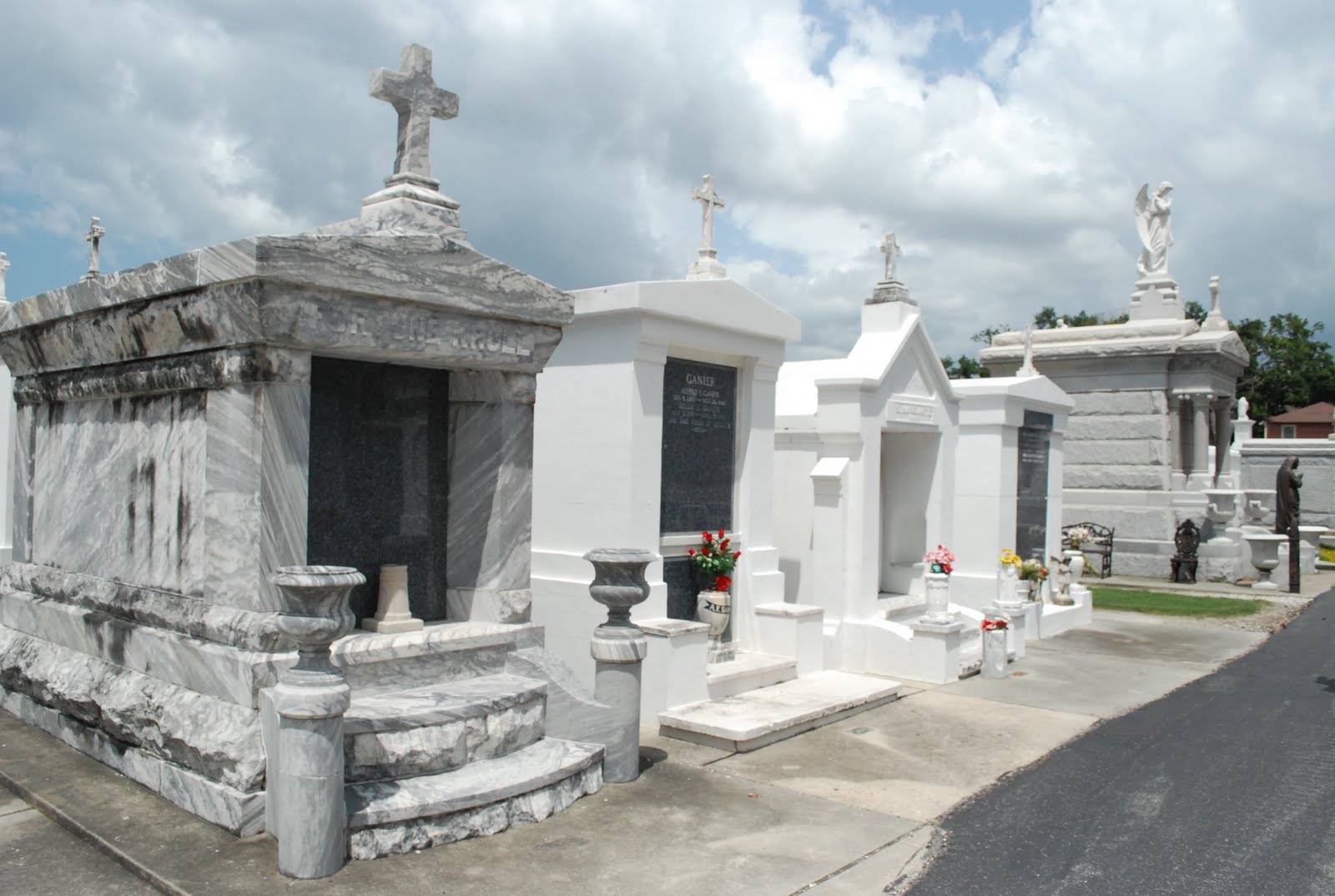
Ghosts and vampires may or may not exist, but one piece of New Orleans culture might be the most chilling of all. In the cemeteries, bodies are buried above ground because of the high water table. These family tombs are like real estate, and as with any property, there is a limited supply. (Do you know where I'm going with this?) After at least a year and a day (an old rule that allows for the quick decomposition that occurs in the NOLA climate), when there is a new body to be interred, the coffins of previous residents are removed and destroyed. The contents/remains/bones are pushed back into the crypts underneath (called caveaux) to make room for the incoming deceased. (Creeped-out yet?) As I mentioned, these tombs are property, and as such can be sold. New owners can agree to let the remains of the previous stay, or, they can insist that the tomb be cleaned out and the bones deposited elsewhere. (Shiver.)

In case you're wondering, no pictures of me sleeping in my comfy white Hotel Monteleone bed taken from the ceiling materialized on my memory card. (Phew!) How would I have reacted to that?! The Monteleone is supposed to be haunted, too, but I haven't heard any tales, or looked for any, either.

Wednesday, June 29, 2011

New Orleans Captivates Margaret, (Part 1)


Sitting on the airplane, catching up on my journal, I realized I would have to limit my New Orleans posts to the sights and experiences that I found the most interesting. It might seem strange to pair a cathedral with street jazz musicians, and then mention piles of powdered sugar with doughnuts underneath, but these are the big surprises of New Orleans. We did visit the famous Bourbon Street, a few times, but it was close to what I expected. I intend to concentrate here on the delightful surprises.

The Cathedral-Basilica of Saint Louis, King of France, sits just north of Jackson Square in the French Quarter. Taken from pretty Jackson Square, almost any photo of the cathedral will have Crepe Myrtle, magnolia, and palm trees in the foreground. I couldn't resist taking a few photos of the Spanish-style cathedral, but I hadn't planned on entering until (of all people) our ghost-and-vampire tourguide advised us not to miss it. It might have been partly the turbo air-conditioning on a beastly-hot day, but to me, the cathedral was breathtaking and I wanted to stay in there and inspect every stained-glass window (those tell Saint Louis's story), every shrine, every ceiling painting, and every piece of Catholic symbolism. This cathedral has more recently (1964) been named a basilica (meaning an archbishop presides here) and the umbrella see left) and bells encased in glass symbolize this important designation. If the Pope should visit, he is greeted with the umbrella, a symbol of hospitality as it is too narrow to protect him from actual rain. The massive organ pipes are framed by an arch illuminated by golden vines and angels reminding me of the prominence of music in this city. The organ was water-damaged during Hurricane Katrina and had to be sent away to be fixed. It was reinstalled in 2008.

I expected to find jazz musicians on the streets of the French Quarter, but I did not expect them to be so good! Almost every block had some unusual combination of instruments playing technically-virtuosic, heartfelt, and intense jazz. My favorite, just down the street from Aunt Sally's Pralines, was a clarinet player endowed with the technical prowess of Benny Goodman jamming with an equally accomplished trombonist. They were playing in a Dixieland style. As a longtime clarinetist who has enjoyed many friendships with trombonists over the years, I appreciated this combination. Music is after all, a kind of conversation between musicians, and jazz is the most personal kind of conversation. As usual, when I heard this clarinet I heard it as my voice even though I never was and never will be as good as the player sitting on this bench. By the way, the bucket says, " My name is Fill=up D. Bucket!"

These guys outside the cathedral were irresistible. I heard the saxophonist alone as I was shooting photos of Jackson Square and the exterior of the cathedral. Then the drummer joined him and added a hot beat and some vocals--WOW!!! I could feel some swing-dance moves coming on, but oh, no partner (shucks).

On the other side of Jackson Square is the famous Cafe du Monde. I couldn't get near this place until my last day in New Orleans because it was so crowded. Finally after our city tour, Linda and I popped in for some beignets in the late afternoon. Sadly though, the sousaphone player who had been there Sunday for this photo was not there to entertain us on Monday. She had the required cafe au lait, but I stuck with a nice cold diet soft drink (they don't say soda). I will admit to making a mess with that powdered sugar, but it was worth it and in my defense, so was everyone else! The small cafe tables were covered with it. I think I might start a movement to replace all Starbucks with Cafes du Monde. What do you think?

Saturday, May 7, 2011

Signs of Spring in Cape May, New Jersey

I remember working on an assignment in second or third grade where we had to go out into nature and find 'Signs of Spring.' We probably had to make some kind of visual presentation, but I don't remember that. I do remember finding buds on trees, tiny leaves, dandelions, and probably pansies. I think of that assignment every year when the trees start to bud, and today as I walked through Cape May on a fabulous five-house Private Home Tour, I identified some Cape May signs of spring.

I did notice more traffic on the southbound highways last night, and I noticed more cars competing with me for the best free parking. But I'm trying to keep this post focused on positive things, so I'll point out that there were many folks biking around the city today. These bikes were parked outside Congress Hall.
It was a warm spring day, so there were quite a few people catching some rays on the beach. You can tell it is not summer because those tents on Steger's...uh, I mean Jackson Street Beach aren't unfurled yet.Tulips, of course. It's actually a little late for tulip viewing, but these looked nice on Washington Street Mall. Cape May takes pride in its tulips because the earliest European residents were Dutch.

So back to that Private Home Tour: loved it. I felt like I was being nosy at first paying money to sniff around other people's homes, but each of the hosts seemed pleased to show off their beautiful homes. I'm going to blog at length about this for the NJ.com Jersey Shore blog, so I won't get into detail here, but I will say this tour was a special treat. Cape May's Mid-Atlantic Center for the Arts and Humanities, the tour organizers, asked that we respect the homeowners' privacy and not take photos inside. Here's a shot of one of my favorites, possibly because the lady of the house is a stitcher and a gardener and that was evident throughout.
Here's my favorite elementary school sign of spring, buds on trees:Each house had a docent stationed on the porch assigned to chat us up until the hosts were ready. One of these docents pointed out something I hadn't realized before. Cape May has trees. Lots of big, old, shade-giving, leaf-shedding trees. Other New Jersey shore towns, not so much. You learn something every tour.

Sunday, March 27, 2011

Longwood Gardens II: Every Flower's Got a Story


I suspect I get my love of flowers from my parents. They always had flowers in the gardens. My father enjoyed shooting photos of flowers, especially those he had grown himself. He experimented with light and filters and backgrounds. We have some nice dahlia photos of his, but most are in the form of slides. Perhaps I was channeling him at Longwood Gardens last week when I took about five hundred flower photos and spent quite a lot of hours sorting and cropping afterward. That's all I do--crop--I don't enhance my photos in any way. This post contains my favorite non-orchid flower photos.

That top photo is a gardenia. That was Mom's favorite flower. I don't remember her growing gardenias until my father passed away and one of her friends bought her a bush to cheer her up. It still thrives in Cape May, and is loaded with pink gardenias in mid-spring. The problem is, Mom loved white gardenias because she carried them when she got married in 1943. She didn't have a fancy white dress or professional photos to remember the day because it was wartime. She and my father were married in their uniforms, U.S. Coast Guard for him and Navy WAVES for her, and the white gardenias were the one luxury. There's now a white gardenia bush next to the pink one in Cape May, purchased in memory of her.

I do remember Mom growing roses. I have never had luck with roses (they practically die when I breathe on them), but Mom grew roses in many colors wherever we lived. Some of her salmon and pink ones still bloom in Cape May, but I don't get too close. I like this photo because I got the blurry background thing right.

Dad's favorite flower, besides dahlias, was the bird of paradise. I remember these growing on the porch of the Cape May house, but once we left Cape May for Staten Island, he turned over his plants to his friend Fred (a mechanic with a greenhouse) for safekeeping. This is my best bird of paradise shot from Longwood:

Generally, I favor hibiscus. Sometimes, I get them to grow and bloom in my own garden. Cape May is a whole different gardening zone from Hamilton, so I'd probably have more luck there except that I'm not there often enough to water them. But here's a nice shot from Longwood:

I pulled out my fish-eye lens to shoot the palm room. The window panes in the background and the palms themselves make a nice effect curved on the sides. There's another one like this that includes Fred (another mechanic, but without a greenhouse) holding my pocketbook. He doesn't like that one.
There's no story behind this shot except that I really like these flowers. I think it's the color. I have one garden beside my house that has almost exclusively this color blooms of different varieties with yellow flowers.

Finally, here's a vintage shot I took in May, 1977, of my parents at the Topiary Garden at Longwood Gardens. (This one I had to touch-up a little bit.)

Longwood Gardens' Orchid Extravaganza

I had been meaning to walk around Longwood Gardens with my camera for months--I missed the chrysanthemums in fall and the holiday lights--but thanks to a great deal from Groupon I got to see the orchid show. Thousands of orchids in countless varieties were worked into the exhibit areas in the Conservatory, and the usual orchid room was full of colorful specimen. I am no orchid expert and wouldn't attempt to grow them, but I can shoot them with the Nikon...I LOVE the unusual color on these:

How do these know to form a perfect sphere?

Is this one my favorite? I'm not sure.