Wednesday, October 29, 2008

Hamilton-Trenton Marsh

I've just added a new online photo album to my list on the right side of this blog. There is now an album of 40 photos from all seasons in the Hamilton-Trenton Marsh. This Mercer County park is behind my house ("location, location, location!") and gives us beautiful views all year. In the winter when the leaves are off the trees, we can see the whole of Spring Lake from the living room. When the leaves form in the spring, we have less of a view, but this means the birds are back! Having the marsh right next door, we see and hear some interesting species, but since I'm not a birder I can't identify all of them. I have seen the usual robins, cardinals, bluejays, goldfinches but also catbirds, red-winged blackbirds, owls, and a pheasant. I'm still trying to get some good photos of these birds.

The marsh is a great place to walk, with a camera or with a dog! Gladys the Sheltie puppy had an interesting experience months ago when she was tiny: she peered over the edge of the lake's bank and saw a puppy looking back a her. As she tried to get a better look, she tumbled head-first into the water! I should have re-named her Narcissus--wasn't he the Greek god who did just about the same thing in a myth? Almost any time of year there are great nature shots. The swans usually cooperate, and there are usually Canada geese and ducks. At the Friends of the Marsh Photography Exhibit (currently at the Ellarslie Museum in Trenton) I have seen some great shots of more unusual species such as great blue herons and beaver. I haven't been lucky enought to catch those yet. Here are my favorite swan and turtle photos:

Sunday, October 12, 2008

Off to Berlin

We rode the superfast train from Cologne to Berlin. It took us only four hours to do what the bus needs twelve hours to do. It didn't seem all that fast, really, unless you try to focus on the ground right next to the track. The buildings and fields further away did not appear to be rushing past any faster than usual. Once at Berlin's mod new station, we were met by our local tour guide and bus. This station is huge with lots of stores and restaurants and lots of glass. (Enrico and our regular bus loaded with our luggage were taking the highway, and managed to meet us at the hotel after our tour.)


Our guide Christabel took us around Berlin and we stopped to visit some of the more interesting sites. First was the Kaiser Wilhelm church which was bombed during WWII. This facade to the right is really all that is left. A modern replacement church was built next to this sight, but the facade of the old church was left as a memorial to things lost in the war.


Eventually we made our way through the city to the Brandenburg Gate. Christabel led us through the center columns which used to be reserved for the kaiser! Finished in 1791, this is the only remaining gate of thirteen that used to stand on the perimeter of the city. Just past the gate is Unter den Lindens Avenue, a street with shops at one end and museums, libraries and performing arts centers at the other. I haven't figured out yet why the Old Library is known as the "Kommode".


It was hard to tell where the former East Berlin starts and West ends, except here by this remaining bit of the wall (below) and Checkpoint Charlie to the right. A lot of the guys from our tour gladly posed for photos in front of the famous checkpoint. The eastern part of the city has been working hard to catch up to the modern west side. I had to refer to my map to see exactly where our hotel sat.


This piece of the wall that wasn't torn down shows how impossible it would be to climb over. It's pretty igh for one thing, and that part that looks like a rubber bumper on top would keep a person from getting a grip good enough to hoist themself over. And then there are rows of barbed wire. Around the city, there are parts of the wall displayed showing the graffitied western side and the immaculate east side.


Finally after a long day of travelling and touring, we relaxed for awhile in our (East Berlin) hotel, a very modern, minimalist place called Moevenpick which is also the name of some German ice cream. This is the kind of place that leaves candy on your pillow. Since we were in Germany, the candy was Haribo Gummy Bears. This was a very fancy hotel by my standards, with a beautiful view out the window, and a bathroom wall made out of glass block. Although we were tempted to stay in that evening and put our feet up, we had signed up for a variety show at the Winter Garden Theater which turned out to be great fun.

Wednesday, October 1, 2008

I'd like to go back...


I'd like to go back to Rothenburg. We only stopped there briefly on our way from Nuremberg to Munich but I was intrigued by the medieval walled town. I've done quite a bit of reading on the middle ages, and like most people, I suppose, I picture that era as dark and dingy. Rothenburg is a medieval town with half-timber buildings in pleasing colors. It was cheerful-medieval. I didn't have time to check out the Medieval Crime Museum, but one of my tourmates did, and it sounds like this would be an exception to the cheerful-medieval vibe in the rest of the town. I spent my time shopping: I bought a three-piece ceramic German oompah band (clarinet, tuba and drums) and a silver cuckoo clock charm for my bracelet. I couldn't leave Rothenburg without buying a couple of the Schneeballs that they are famous for. These are really just strips of pie dough rolled in a ball and sprinkled with sugar, dipped in sticky-sweet glop, or covered in dark chocolate. They weren't a hit with everyone, bu I enjoyed my chocolate-covered Schneeball.


I'd like to go back to Leipzig. This was another quick stop with just enough time to eat lunch and shoot some photos. We chose a great restaurant--Auerbach's Keller--which was the setting for a scene in Goethe's "Faust". It's underneath a shopping area called the Madlerpassage, and its entrance is maked by scultures of events from its history. Anyway, the food was great. My selction was pork rolled in bacon with cauliflower and potatoes.


I was most excited about another Leipig site, the Thomaskirche. This beautiful church saw Martin Luther lectures, Mozart's organ playing, and the baptism of Richard Wagner. But even more importantly, this is where Johann Sebastian Bach spent most of his career. Much of his revered church music was composed for this gig, he met his second wife here (she was a soprano in the choir), and JSB is buried here. Fo a former music major, this is hallowed ground. I'd like to go bach to Leipzig to get a feel for Bach's city and exploe the Bach Museum!

Tuesday, September 30, 2008

Some Castles in Germany

THE RHINE CRUISE


Our first sightseeing excursion of the tour was a cruise on the Rhine River. There were castles, churches and towns on either side. The castles and castle ruins are the highlights, appearing one after another with little property surrounding them. (Eleventh-century Sooneck Castle is above, and Reichenstein Castle from 1192 is below.) These mostly anonymous medieval landowners were always jousting with their neighbors for more land.


SANSSOUCI


I've had this unread book on my shelf for 22 years that I bought in the 1980s after hearing a review on the radio. It's a biography of the non-anonymous Frederick the Great, King of Prussia. We music majors knew about Frederick because he was an excellent flutist and notable patron of the arts. We visited his palace on the tour, Sanssouci in Potsdam. Sanssouci means "without worries" and this palace became a headquarters for intellectuals and Frederick's sophisticated friends. Voltaire lived here for three years. Frederick's tomb is on the grounds, and visitors leave flowers and potatoes on it. Why potatoes? Because Frederick brought the plant to Germany to feed the hungry poor. He forgot to tell them right away that they were supposed to eat the bottom part of the plant. They were eating the leaves and not liking it very much.


CECILIENHOF


The other palace in Potsdam is Cecilienhof, where the Potsdam Conference starring Roosevelt, Churchill, and Stalin, and later Truman, Attlee, and Stalin, took place. It was in this palace that they signed the Potsdam Agreement after World War II.


LINDERHOF


Another superstar king was Ludwig II (sometimes referred to as Mad King Ludwig). He built

three famous iconic German castles, and we visited two on this tour. First, Linderhof with its man-made grotto and countless priceless porcelain vases. This castle, decorated in exaggerated Rococo style if tht's possible, features a waterfall fountain outside Ludwig's bedroom window. (see right.)


Linderhof's man-made Venus Grotto, a ten-minute walk up a steep hill, was a retreat for the king where he had his buddy Richard Wagner's opera, Tannhauser, performed while he floated around the man-made grotto lake in a boast shaped like a scallop shell. (Think Botticelli's "The Birth of Venus".)


NEUSCHWANSTEIN

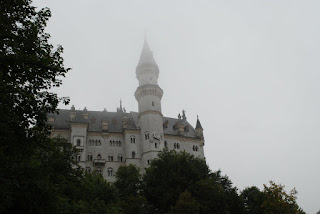
Ludwig's other famous castle, Neuschwanstein, also has a grotto inspired by the work of Richard Wagner, but it also features a bigger tribute. The singer's Hall, a fancy Rococo auditorium, is decorated with murals depicting scenes from Wagner's operas. Ludwig loved music and he loved reading: both of these castles feature upholstered reading nooks. This is the famous fairy tale castle that inspired Cinderella's place at Disneyworld. We missed out on the "money shot" photo of the castle because of clouds, but there were still plenty of photo opps on the property:

Sunday, September 28, 2008

Back from Germany!

There are things that make life wonderful, but those things are not the same for everyone. For me it has always been music, art, a good story, and good friends. In recent years it has become clear to me that travel is one of those things, too.


from the Rhine cruise: Ehrenfels Castle Ruin


I've just returned from a tour of Germany organized by professionals instead of by me, and I had a great time. I'm tired physically, but my mind is re-traveling to all these places, sorting them out and selecting the favorites. I never thought I would enjoy such a tour with the early wake-up calls and limited time at interesting sights, but I was wrong. We got to know almost all of the other 41 people on the tour, eating with different groups for breakfast and supper. We saw lots of sights and were kept on time by our amazing tour director Renske. I could never have planned such an interesting tour on my own, nor could I have stayed in such nice hotels. Renske told us some great stories from the history and culture of the various regions (one of my pillars of a beautiful life, remember). The food was great--either the hotel meals or the places we tried on our own. It was such a nice change to get my nose out of the travel guide and put the control in her (and Globus's) hands. Our excursions (included and optional alike) were planned efficiently around times they are least busy (and not closed for local holidays or renovation). This is stuff the average tourist wouldn't know.
(Furstenberg Ruin 1219)


The transportation was always figured out for us whether it was by bus, boat, or train. Our amazing driver Enrico took us through cities and mountains, and down hundreds of miles of highway, making it look easy all the time. He had the responsibility of loading our luggage on the bus almost everyday, and I know first hand some of those bags are HEAVY.


Rhine River tour boat


So I'm a changed person. Tours are now an official kind of travel, one of my five pillars of beauty in life. Now it is my task to sort through my just-under-one-thousand photos and sort out all of the castles, churches, towns, cities, markets, and statues we saw!


Flower stand in Munich


East Berlin


Friday, September 12, 2008

Hoist the Jolly Roger: International Talk Like A Pirate Day

Sadly, scallywags, I'll be in Germany (Cologne and Berlin) on International Talk Like a Pirate Day (where it is something like Sprechen Sie wie ein Pirat Tag). While I'm gone, I hope my readers will check out Cap'n Slappy and Ol' Chumbucket's page, http://www.talklikeapirate.com/ for tips on how to celebrate this festive holiday. At the very least, visit http://www.piratequiz.com/ where you can get your own Pirate Name.

If you're way too serious for any of this silly pirate stuff, I would recommend Pirate Wisdom: Lessons in Navigating the High Seas of Your Organization by Elisa S Robyn, Ph.D. and Cindy L. Miles, Ph.D. (iUniverse, 2006). I heard one of the authors speak at a conference thinking this would be a fun topic to finish off the busy day of listening. How surprised was I when this pirate metaphor turned out to be a well-thought-out philosophy on getting things done at work (or at school or any organization) without going through the usual procedures. Consider the sailboat that needs to sail into the wind. Sailing directly into the wind would require too much energy and would take too long (folly), but a zigzag pattern would eventually get the sailboat there more efficiently. This is called tacking upwind. Imagine approaching a challenge at work this way, and you've got the idea of Pirate Wisdom. You'd eventually get to the solution even if you didn't go directly from point A to point B.

Wednesday, September 10, 2008

Cape May Stage: Doubt


Cape May is lucky to have two professional theater groups in town. The other night I attended the Cape May Stage production of John Patrik Shanley's "Doubt". The beautifully-restored Robert Shackleton Playhouse was packed for this show. I'd been wanting to check out this group, but with all the cultural activities available in Cape May now, it took a while to get around to this theater. I'm glad I waited, not only because I got to see a great production of "Doubt", but because Cape May Stage donated half the proceeds from the evening to the Beach Theater Foundation. I'm already a frequent filmgoer at the Beach Theater.

The play started around dusk, and from across the street the Robert Shackleton Theater looked so cute lit up with a line of people waiting to get in. It was September, but it could have been a picture on a Christmas card. Right behind where I was standing to take this photo, a barbershop quartet in Hawaiian shirts was warming up in the Rotary Gazebo. It was nice to see the theater close-up so that I could inspect the amazing award-winning restoration work that was completed a few years ago. Before Cape May Stage took over the building, it was a sad-looking welcome center that sometimes hosted small events. Now it is a gorgeous theater with stadium seating and a palette of muted colors.
The play was a thought-provoking experience, exploring the concept of doubt in a Catholic school. With only four actors, the story was rich (after all it won the Pulitzer Prize and the Tony Award for Best Play). I'm no theater critic, but the acting was good, the characters believable, and the scenery was minimal but just right. The audience surrounding me was spellbound by the performance and rewarded the actors with a storm of applause.